MCQ
Incorrect statement regarding $BF_2NH_2$ molecule is
  • A
    $FBF$ bond angle $< 120^o$
  • B
    $HNH$ bond angle $> 109^o28'$
  • C
    Exlubits intermolecular $H-$ bond
  • Hybridization of $N-$ atom is $sp^3$

Answer

Correct option: D.
Hybridization of $N-$ atom is $sp^3$
d
$*$ Both boron and nitrogen are $sp^2-$ hybridised.

$*\, FBF$ bond angle $< 120^o$ ($VSPER$ theory)

$* \,H N H$ bond angle is less than $120^o$ but greater than $109^o28$' due to  back bonding. 

$*$ Due to presence of $H-$ atom attached to nitrogen this molecule can exhibits  intermolecular $H-$ bonding.

Need a full question paper?

Generate a complete, print-ready paper with questions like this in minutes — across 16+ boards, with answer keys.

Start Generating Free

Similar questions

The correct electron affinity order is $(EA = -\Delta H_{EG})$ 
$C{{H}_{3}}-C{{H}_{2}}-C{{H}_{2}}-C{{H}_{2}}-C{{H}_{3}}\xrightarrow{C{{H}_{2}}{{N}_{2}}/\Delta } Product$

Which of the following product $(s)$ is/are can be obtained in the above reaction.

The depletion of ozone leads to the formation of :
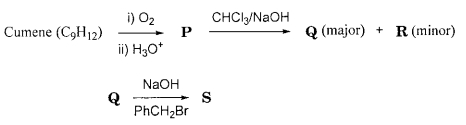
The correct statement($s$) about the following reaction sequence is(are)

(image)

($A$) $R$ is steam volatile

($B$) $Q$ gives dark violet coloration with $1 \%$ aqueous $FeCl_3$ solution

($C$) $S$ gives yellow precipitate with $2, 4$-dinitrophenylhydrazine

($D$) $S$ gives dark violet coloration with $1 \%$ aqueous $FeCl_3$ solution
The percentage of pyridine $(C_5H_5N)$ that forms pyridinium ion $(C_5H_5N^+H)$ in a $0.10\, M$ aqueous pyridine solution ($K_b$ for $C_5H_5N = 1.7 \times 10^{-9}$) is
Which of the following are not redox reactions?
a) $K _4\left[ Fe ( CN )_6\right]+ H _2 SO _4+ H _2 O \rightarrow K _2 SO _4+ CO + FeSO _4+\left( NH _4\right)_2 SO _4$.
b) $CuSO _4+ NH _3 \rightarrow\left[ Cu \left( NH _3\right)_4 SO _4\right.$.
c) $M g+N_2 \rightarrow M g_3 N_2$
d) $I_2+3 Cl _2 \rightarrow 2 ICl _3$
Which substance has the strongest London dispersion forces?
Which of the following isotope of hydrogen has maximum sum of electron $+$ proton $+$ neutron?
Match the conditions and the temperature for the 'fusion' process of $H_2O(s)$ at $1\, atm$ pressure

Condition Temperature
$(1)$ Spontaneous $(p)$ $273\,K$
$(2)$ At equilibrium $(q)$ $260\, K$
$(3)$ Non-spontaneous $(r)$ $280\, K$


Which of the following will have a meso isomer also