MCQ
Increasing order of atomic radii is
  • $M{g^{2 + }} < N{a^ + } < Ne < {F^ - } < {O^{2 - }}$
  • B
    $N{a^ + } < M{g^{ + + }} < Ne < {F^ - } < {O^{2 - }}$
  • C
    ${O^{2 - }} < {F^ - } < Ne < N{a^ + } < M{g^{2 + }}$
  • D
    $Ne < {O^{2 - }} < {F^ - } < N{a^ + } < M{g^{2 + }}$

Answer

Correct option: A.
$M{g^{2 + }} < N{a^ + } < Ne < {F^ - } < {O^{2 - }}$
a
All the species are iso-electronic $\left(10 e ^{-}\right)$

For iso-electronic species more the positive change, smaller the ionic radii.

For iso-electronic species more negative change, bigger the ionic radii

Hence the order is $Mg ^{2+}\,<\, Na ^{+}\,<\, F ^{-}\,<\, O ^{2-}$

Need a full question paper?

Generate a complete, print-ready paper with questions like this in minutes — across 16+ boards, with answer keys.

Start Generating Free

Similar questions

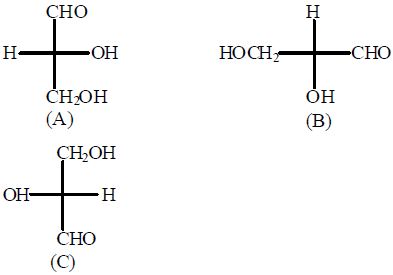
Which of the following statements is not correct about $(A), (B)$ and $(C) -$
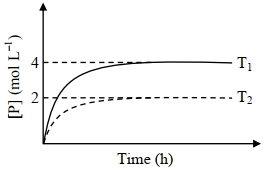
In a one-litre flask, 6 moles of $A$ undergoes the reaction $A(\mathrm{~g}) \rightleftharpoons \mathrm{P}(\mathrm{g})$. The progress of product formation at two temperatures (in Kelvin), $\mathrm{T}_1$ and $\mathrm{T}_2$, is shown in the figure:

If $T_1=2 T_2$ and $\left(\Delta G_2^{\Theta}-\Delta G_1^{\varphi}\right)=R T_2 \ln x$, then the value of $x$ is. . . . .

$\left[\Delta G_1^\theta\right.$ and $\Delta G_2^\theta$ are standard Gibb's free energy change for the reaction at temperatures $T_1$ and $T_2$, respectively.]

The stepwise formation of $\left[ Cu \left( NH _{3}\right)_{4}\right]^{2+}$ is given below

$Cu ^{2+}+ NH _{3} \stackrel{ K _{1}}{\rightleftharpoons}\left[ Cu \left( NH _{3}\right)\right]^{2+}$

$\left[ Cu \left( NH _{3}\right)\right]^{2+}+ NH _{3} \stackrel{ K _{2}}{\rightleftharpoons}\left[ Cu \left( NH _{3}\right)_{2}\right]^{2+}$

$\left[ Cu \left( NH _{3}\right)_{2}\right]^{2+}+ NH _{3} \stackrel{ K _{3}}{\rightleftharpoons}\left[ Cu \left( NH _{3}\right)_{3}\right]^{2+}$

$\left[ Cu \left( NH _{3}\right)_{3}\right]^{2+}+ NH _{3} \stackrel{ K _{4}}{\rightleftharpoons}\left[ Cu \left( NH _{3}\right)_{4}\right]^{2+}$

The value of stability constants $K _{1}, K _{2}, K _{3}$ and $K _{4}$ are $10^{4}, 1.58 \times 10^{3}, 5 \times 10^{2}$ and $10^{2}$ respectively. The overall equilibrium constants for dissociation of $\left[ Cu \left( NH _{3}\right)_{4}\right]^{2+}$ is $x \times 10^{-12}$ The value of $x$ is ...............

(Rounded off to the nearest integer)
$1$  mole of conc. $HCl $ requires $X$  moles of dilute $NaOH$  for neutralisation and $1$  mole of concentrate ${H_2}S{O_4}$ requires $Y$ moles of small dilute $NaOH$ then which of the following reaction is true
What will be the $pH$ of a solution formed by mixing $40\, cm^3$ of $0.1\, M \,HCl$ with $10\, cm^3$ of $0.45\, M \,NaOH$
At temperature $T$, the average kinetic energy of any particle is $\frac{3}{2} KT$ . The de Broglie wavelength follows the order
The enthalpy of combustion of methane, graphite and dihydrogen at 298 K are, $-890.3 kJ mol ^{-1},-393.5 kJ mol ^{-1}$ and $-285.8 kJ mol ^{-1}$ respectively. Enthalpy of formation of $CH _4(g)$ will be
Ozone hole refers to :
For conversion $C$ (graphite) $→ C$ (diamond) the $\Delta S$ is
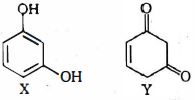
At normal temperature, $X$ and $Y$