Question
Increasing order of electron affinity is

Answer

c
Let us arrange the elements according to the way they are arranged in the periodic table.

Lithium ,Beryllium ,Boron ,Carbon ,Nitrogen ,Oxygen, Fluorine, Aluminium Chlorine

As we move from Lithium to fluorine the electron affinity increases and as we move from Fluorine to chlorine and further electron affinity decreases. Hence electron affinity of chlorine should be greater than oxygen and oxygen should be greater than nitrogen and nitrogen should be greater than aluminium. As we move down, the size increases, and due to that, the electron affinity decreases as it is the tendency to gain electrons. Metals do not gain electrons, nonmetals do. So, aluminum is at the last position.

Need a full question paper?

Generate a complete, print-ready paper with questions like this in minutes — across 16+ boards, with answer keys.

Start Generating Free

Similar questions

. $C{H_3} - C \equiv CH\mathop {\xrightarrow{{{O_3}}}}\limits_{Zn/{H_2}{O_2}} {\text{Product}}$   

Product in above reaction is

Of the following complex ions, which is diamagnetic in nature?
A coordinate bond is formed when an atom in a molecule has
If $0.50\,mol$ of $CaC{l_2}$ is mixed with $ 0.20\,mol$ of $N{a_3}P{O_4}$, the maximum number of moles of $C{a_3}{(P{O_4})_2}$ which can be formed, is
If the ionization enthalpy and electron gain enthalpy of an element are $275$ and  $86\, kcal\, mol^{-1}$ respectively, then the electronegativity of the element on the  Pauling scale is 
Three moles of an ideal gas expanded spontaneously into vacuum. The work done will be .............. $\mathrm{Joules}$
The boiling point of water in a $0.1$ molal silver nitrate solution (solution $A$ ) is $x ^{\circ} C$. To this solution A, an equal volume of $0.1$ molal aqueous barium chloride solution is added to make a new solution $B$. The difference in the boiling points of water in the two solutions $A$ and $B$ is $y \times 10^{-2}{ }^{\circ} C$.

(Assume : Densities of the solutions $A$ and $B$ are the same as that of water and the soluble salts dissociate completely.)

Use: Molal elevation constant (Ebullioscopic Constant), $K _{ b }=0.5 K kg mol ^{-1}$; Boiling point of pure water as $100^{\circ} C$.)

($1$) The value of $x$ is

($2$) The value of $|y|$ is
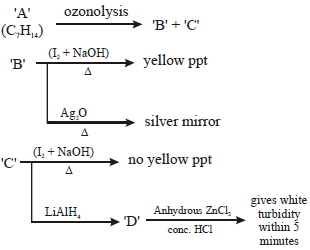
Consider the following reactions $A$ is
Sum of $x + y =$ ?
Ethylidine dichloride can be prepared by the reaction of $HCl$ and
