Question
✓
Answer
| Rainfall (mm) | Number of sub-divisions (f) | Cumulative frequency |
| 200-400 | 2 | 2 |
| 400-600 | 4 | 6 |
| 600-800 | 7 | 13 |
| 800-1000 | 4 | 17 |
| 1000-1200 | 2 | 19 |
| 1200-1400 | 3 | 22 |
| 1400-1600 | 1 | 23 |
| 1600-1800 | 1 | 24 |
| N = 24 |
We have, $N=\Sigma f_i=24 \Rightarrow \frac{N}{2}=12$
The cumulative frequency just greater than $\frac{N}{2}$ i.e. 12 is 13 and the corresponding class is 600-800. It is the median class with l = 600 f = 7 h = 200 and F = 6.
$\therefore \quad$ Median $=l+\frac{\frac{N}{2}-F}{f} \times h \Rightarrow$ Median $=600+\frac{12-6}{7} \times 200=600+171.4=771.4 mm$
(iii)
Computation of Mean
| Rainfall (mm) | Mid values $\left(x_i\right)$ | $\frac{x_i-1100}{200}=u_i$ | Number of Sub-divisions $\left(f_i\right)$ | $f_i u_i$ |
| 200-400 | 300 | -4 | 2 | -8 |
| 400-600 | 500 | -3 | 4 | -12 |
| 600-800 | 700 | -2 | 7 | -14 |
| 800-1000 | 900 | -1 | 4 | -4 |
| 1000-1200 | 1100 | 0 | 2 | 0 |
| 1200-1400 | 1300 | 1 | 3 | 3 |
| 1400-1600 | 1500 | 2 | 1 | 2 |
| 1600-1800 | 1700 | 3 | 1 | 3 |
| $\Sigma f_i u_i=-30$ |
We find that a = 1100 200, N = 24
Mean $=a+h \times\left(\frac{1}{N} \Sigma f_i u_i\right) \Rightarrow$ Mean $=1100+200 \times \frac{-30}{24}=1100-250=850 mm$
(IV) Number of sub-divisions having at least 1000 m rainfall = 2 + 3 + 1 + 1 = 7.
Hence, 7 sub-divisions have good rainfall
Need a full question paper?
Generate a complete, print-ready paper with questions like this in minutes — across 16+ boards, with answer keys.
Explore more
Similar questions
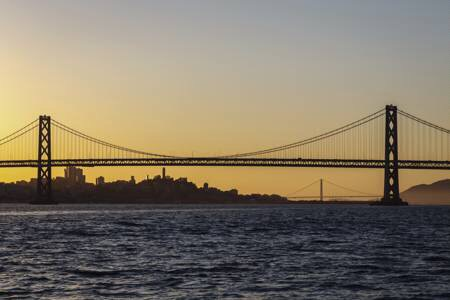
Applications of Parabola - Suspension Bridge
If the road the roadway of a suspension bridge is loaded uniformly par horizontal meter, the suspension cable hangs in the form of arc which closely approximate to parabolic arcs. Therefore, parabolic arcs are used in suspension cable bridge construction.
Parabola: A parabola is the graph that results from $px(x) = ax^2 + bx + c$. Parabola are symmetric about a vertical line known as the Axis of symmetry.
- Find the number of polynomial having zeroes as 1 and -2.
- Graph of quadratic polynomial is a:
- If the susnension cable of a bridge hangs in the form of arcs is represented by $4x^2- 20x + 9,$ then its zerores are:
Or
The number of zeroes that polynomial $p(x) = x^3 - 4x$ can have is:
The angle of elevation of the top of a vertical tower PQ from a point X on the ground is 60°. At a point Y, 40m vertically above X, the angle of elevation of the top is 45°. Calculate the height of the tower.
A backyard is in the shape of a triangle $\text{ABC}$ with right angle at $B$. $AB =7 m$ and $BC =15 m$. A circular pit was dug inside it such that it touches the walls $A C, B C$ and $A B$ at $P, Q$ and $R$ respectively such that $AP =x m$.
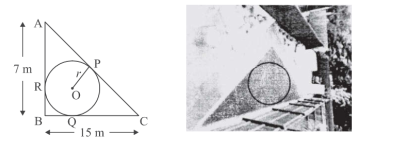
Based on the above information, answer the following questions:
$(i)$ Find the length of $AR$ in terms of $x$.
$(ii)$ Write the type of quadrilateral $\text{BQOR} $.
$(iii) \ (a)$ Find the length $PC$ in terms of $x$ and hence find the value of $x$.
OR
$(b)$ Find $x$ and hence find the radius $r$ of circle.
→Based on the above information, answer the following questions:
$(i)$ Find the length of $AR$ in terms of $x$.
$(ii)$ Write the type of quadrilateral $\text{BQOR} $.
$(iii) \ (a)$ Find the length $PC$ in terms of $x$ and hence find the value of $x$.
OR
$(b)$ Find $x$ and hence find the radius $r$ of circle.
In a pool at an aquarium, a dolphin jumps out of the water travelling at 20 cm per second. Its height above water level after $t$ seconds is given by $h=20 t-16 t^2$.
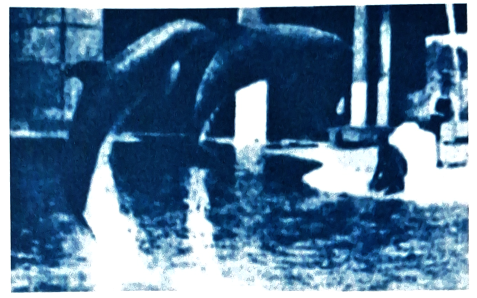
(i) Find zeroes of polynomial $p(t)=20 t-16 t^2$.
(ii) Which of the following type of graph represents $p(t)$ ?
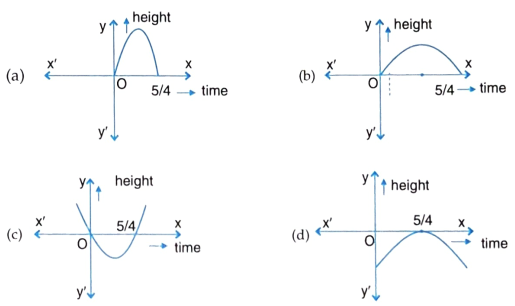
(iii) What would be the value of $h$ at $t=\frac{3}{2}$ ? Interpret the result.
(iv) How much distance has the dolphin covered before hitting the water level again?
→(i) Find zeroes of polynomial $p(t)=20 t-16 t^2$.
(ii) Which of the following type of graph represents $p(t)$ ?
(iii) What would be the value of $h$ at $t=\frac{3}{2}$ ? Interpret the result.
(iv) How much distance has the dolphin covered before hitting the water level again?
In an annual day function of a school, the organizers wanted to give a cash prize along with a memento to their best students. Each memento is made as shown in the figure and its base $A B C D$ is shown from the front side. The rate of silver plating is ₹ $20$ per $cm ^2$. Based on the above, answer the following questions:
(i) What is the area of the quadrant $O D C O$ ?
(ii) Find the area of $\triangle A O B$.
(iii) What is the total cost of silver plating the shaded part $A B C D$ ?
(iv) What is the length of arc $C D$ ?
→(i) What is the area of the quadrant $O D C O$ ?
(ii) Find the area of $\triangle A O B$.
(iii) What is the total cost of silver plating the shaded part $A B C D$ ?
(iv) What is the length of arc $C D$ ?
A group of sludents of class $X$ visited India Gate on an educatonal trip. The teacher as well as students had interest in history behind India Gate. The teacher narrated that India Gate's, official name is Delhn Memorial, Originally called All India War Memorial, a monumental sand stone arch in New Delhi, dedicated to the troops of British India who died in wars fought between 1914 and 1919. The teacher also said that Indw Gate, whels is located at the eastern end of the Kartanya Path (formerly called the Rajpath), is about 138 feet ( 42 metres) in height.
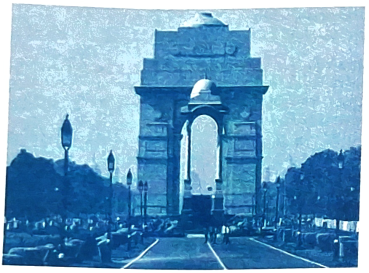
(i) What is the angle of elevation if they are standing at a distance of 42 metres away from the monument?
(a) $30^{\circ}$ $\qquad$ (b) $45^{\circ}$ $\qquad$ (c) $60^{\circ}$ $\qquad$ (d) $0^{\circ}$
(ii) If they want to see the top at an angle of $60^{\circ}$, then the distance where they should stand is
(a) 24.24 m $\qquad$ (b) 20.12 m $\qquad$ (c) 24.64 m $\qquad$ (d) 25.24 m
(iii) If the altitude of the Sun is at $60^{\circ}$, then the height of the vertical tower that will cast a shadow of length 20 m , is
(a) $20 \sqrt{3} m$ $\qquad$ (b) $\frac{20}{\sqrt{3}} m$ $\qquad$ (c) $\frac{15}{\sqrt{3}} m$ $\qquad$ (d) $15 \sqrt{3} m$
(iv) If the ratio of the length of a rod and its shadow is $1: 1$, the angle of elevation of the Sun is
(a) $30^{\circ}$ $\qquad$ (b) $45^{\circ}$ $\qquad$ (c) $60^{\circ}$ $\qquad$ (d) $90^{\circ}$
→(i) What is the angle of elevation if they are standing at a distance of 42 metres away from the monument?
(a) $30^{\circ}$ $\qquad$ (b) $45^{\circ}$ $\qquad$ (c) $60^{\circ}$ $\qquad$ (d) $0^{\circ}$
(ii) If they want to see the top at an angle of $60^{\circ}$, then the distance where they should stand is
(a) 24.24 m $\qquad$ (b) 20.12 m $\qquad$ (c) 24.64 m $\qquad$ (d) 25.24 m
(iii) If the altitude of the Sun is at $60^{\circ}$, then the height of the vertical tower that will cast a shadow of length 20 m , is
(a) $20 \sqrt{3} m$ $\qquad$ (b) $\frac{20}{\sqrt{3}} m$ $\qquad$ (c) $\frac{15}{\sqrt{3}} m$ $\qquad$ (d) $15 \sqrt{3} m$
(iv) If the ratio of the length of a rod and its shadow is $1: 1$, the angle of elevation of the Sun is
(a) $30^{\circ}$ $\qquad$ (b) $45^{\circ}$ $\qquad$ (c) $60^{\circ}$ $\qquad$ (d) $90^{\circ}$
"Eight Ball" is a game played on a pool table with $15$ balls numbered $1$ to $15$ and $a$ "cue ball" that is solid and white. Of the $15$ numbered balls, eight are solid $($non$-$white$)$ coloured and numbered $1$ to $8$ and seven are striped balls numbered $9$ to $15.$
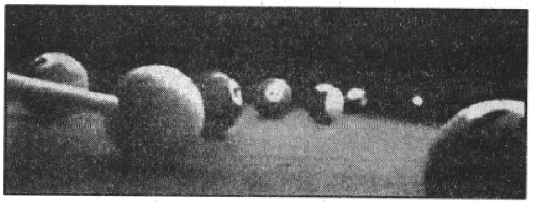
The $15$ numbered pool balls $($no cue ball$)$ are placed in a large bowl and mixed, then one ball is drawn out at random.
Based on the above information, answer the following questions:
$(i)$ What is the probability that the drawn ball bears number $8$?
$(ii)$ What is the probability that the drawn ball bears an even number?
OR
What is the probability that the drawn ball bears a number, which is a multiple of $3$ ?
$(iii)$ What is the probability that the drawn ball is a solid coloured and bears an even number?
→The $15$ numbered pool balls $($no cue ball$)$ are placed in a large bowl and mixed, then one ball is drawn out at random.
Based on the above information, answer the following questions:
$(i)$ What is the probability that the drawn ball bears number $8$?
$(ii)$ What is the probability that the drawn ball bears an even number?
OR
What is the probability that the drawn ball bears a number, which is a multiple of $3$ ?
$(iii)$ What is the probability that the drawn ball is a solid coloured and bears an even number?
Read the following text carefully and answer the questions that follow:
Basant Kumar is a farmer in a remote village of Rajasthan. He has a small square farm land. He wants to do fencing of the land so that stray animals may not enter his farmland. For this, he wants to get the perimeter of the land. There is a pole at one corner of this field. He wants to hang an effigy on the top of it to keep birds away. He standing in one corner of his square field and observes that the angle subtended by the pole in the corner just diagonally opposite to this corner is $60^{\circ}$. When he retires 80 m from the corner, along the same straight line, he finds the angle to be $30^{\circ}$.
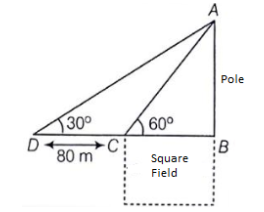
$i$. Find the height of the pole too so that he can arrange a ladder accordingly to put an effigy on the pole.
$ii$. Find the length of his square field so that he can buy material to do the fencing work accordingly.
$iii$. Find the Distance from Farmer at position $C$ and top of the pole?
OR
Find the Distance from Farmer at position $D$ and top of the pole?
→Basant Kumar is a farmer in a remote village of Rajasthan. He has a small square farm land. He wants to do fencing of the land so that stray animals may not enter his farmland. For this, he wants to get the perimeter of the land. There is a pole at one corner of this field. He wants to hang an effigy on the top of it to keep birds away. He standing in one corner of his square field and observes that the angle subtended by the pole in the corner just diagonally opposite to this corner is $60^{\circ}$. When he retires 80 m from the corner, along the same straight line, he finds the angle to be $30^{\circ}$.
$i$. Find the height of the pole too so that he can arrange a ladder accordingly to put an effigy on the pole.
$ii$. Find the length of his square field so that he can buy material to do the fencing work accordingly.
$iii$. Find the Distance from Farmer at position $C$ and top of the pole?
OR
Find the Distance from Farmer at position $D$ and top of the pole?
Mathematics teacher of a school took her 10 ^ (th) standard students to show Red Fort. It was a part of their Educational trip The teacher had interest in history as well. She narrated the facts of Red Fort to students. Then the teacher said in this monument one can find combination of solid figures. There are 2 pillars which are cylindrical in shape. Also, 2 domes at the corners which are hemispherical and 7 smaller domes at the centre. Flag hoisting ceremony on Independence Day takes place near these domes.
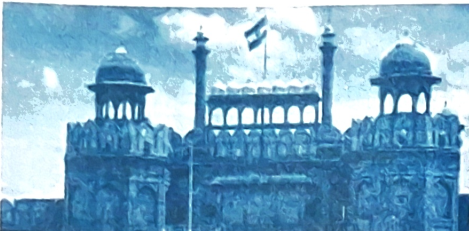
(i) How much cloth material will be required to cover 2 big domes each of radius 2.5 metres?
$($ Take $\pi=22 / 7)$
(a) $75 m^2$$\quad$ (b) $78.57 m^2$$\quad$ (c) $87.47 m^2$$\quad$(d) $25.8 m^2$
(ii) Write the formula to find the volume of a cylindrical pillar.
(a) $\pi r^2 h$$\quad$ (b) $\pi r l$$\quad$ (c) $\pi r(i+r)$$\quad$ (d) $2 \pi r$
(iii) Find the lateral surface area of two pillars if height of the pillar is 7 m and radius of the base is 1.4 m.
(a) $112.3 cm^2$$\quad$ (b) $123.2 m^2$$\quad$ (c) $90 m^2$$\quad$ (d) $345.2 cm^2$
(iv) How much is the volume of a hemisphere if the radius of the base is 3.5 m?
(a) $85.9 m^3$$\quad$ (b) $80 m^3$$\quad$ (c) $98 m^2$$\quad$ (d) $89.83 m^3$
→(i) How much cloth material will be required to cover 2 big domes each of radius 2.5 metres?
$($ Take $\pi=22 / 7)$
(a) $75 m^2$$\quad$ (b) $78.57 m^2$$\quad$ (c) $87.47 m^2$$\quad$(d) $25.8 m^2$
(ii) Write the formula to find the volume of a cylindrical pillar.
(a) $\pi r^2 h$$\quad$ (b) $\pi r l$$\quad$ (c) $\pi r(i+r)$$\quad$ (d) $2 \pi r$
(iii) Find the lateral surface area of two pillars if height of the pillar is 7 m and radius of the base is 1.4 m.
(a) $112.3 cm^2$$\quad$ (b) $123.2 m^2$$\quad$ (c) $90 m^2$$\quad$ (d) $345.2 cm^2$
(iv) How much is the volume of a hemisphere if the radius of the base is 3.5 m?
(a) $85.9 m^3$$\quad$ (b) $80 m^3$$\quad$ (c) $98 m^2$$\quad$ (d) $89.83 m^3$
Johan and Jayant are very close friends. They decided to go to Ranikhet with their families in Separate cars. Johan's car travels at a speed of $x km / hr$ while Jayant's car travels $5 km / hr$ faster than Johan's car. Johan took 4 hours more than Jayant to complete the Journey of 400 km .
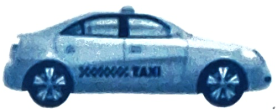
(i) The distance covered by Jayant's car in two hours is
(a) $2(x+5) km$ $\qquad$ (b) $(x-5) km$
(c) $2(x+10) km$ $\qquad$ (d) $(2 x+5) km$
(ii) The quadratic equation describing the speed of Johan's car is
(a) $x^2-5 x-500=0$ $\qquad$ (b) $x^2+4 x-400=0$
(c) $x^2+5 x-500=0$ $\qquad$ (d) $x^2-4 x+400=0$
(iii) The speed of Johan's car is (in km/hour)
(a) 20 $\qquad$ (b) 15 $\qquad$ (c) 25 $\qquad$ (d) 10
(iv) The speed of Jayant's car in $km / hr$ is
(a) 25 $\qquad$ (b) 20 $\qquad$ (c) 30 $\qquad$ (d) 15
→(i) The distance covered by Jayant's car in two hours is
(a) $2(x+5) km$ $\qquad$ (b) $(x-5) km$
(c) $2(x+10) km$ $\qquad$ (d) $(2 x+5) km$
(ii) The quadratic equation describing the speed of Johan's car is
(a) $x^2-5 x-500=0$ $\qquad$ (b) $x^2+4 x-400=0$
(c) $x^2+5 x-500=0$ $\qquad$ (d) $x^2-4 x+400=0$
(iii) The speed of Johan's car is (in km/hour)
(a) 20 $\qquad$ (b) 15 $\qquad$ (c) 25 $\qquad$ (d) 10
(iv) The speed of Jayant's car in $km / hr$ is
(a) 25 $\qquad$ (b) 20 $\qquad$ (c) 30 $\qquad$ (d) 15