Question
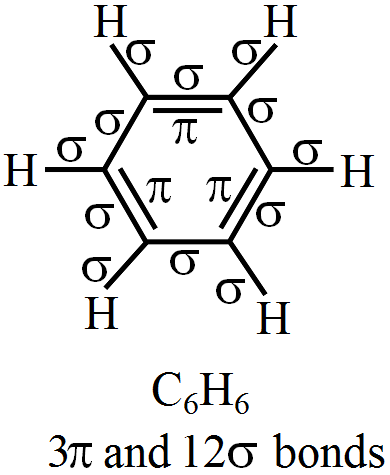
Indicate the $\sigma$ and $\pi$ bonds in the following molecules:
C6H6,

Answer

The $\sigma$ and $\pi$ bonds are indicated below:

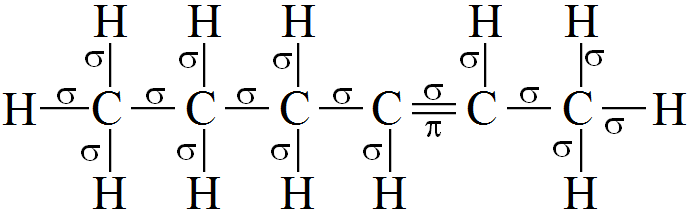
C6H12 can be either:
Straight chain compound
H3C-H2C-H2C-HC+CH-CH3

$\begin{matrix}6\text{C} - \text{C} & \sigma- \text{ bonds}\\12 \text{C} - \text{H} & \sigma-\text{bonds} \\ 1\text{C}-\text{C} & \pi-\text{bond}\end{matrix}\Bigg\}$ Other straight chain isomers will also have the same no. of $\sigma$  and $\pi$-bonds.

Need a full question paper?

Generate a complete, print-ready paper with questions like this in minutes — across 16+ boards, with answer keys.

Start Generating Free

Similar questions

Discuss the chemistry of Lassaigne's test.
At 700K, equilibrium constant for the reaction:
$\text{H}_2\text{ (g) + I}_2\text{ (g)}\rightleftharpoons2\text{HI (g)}$ is 54.8. If 0.5 mol L–1 of HI(g) is present at equilibrium at 700K, what are the concentration of H2(g) and I2(g) assuming that we initially started with HI(g) and allowed it to reach equilibrium at 700K?
What is the valence shell electron pair repulsion principle? Explain how this determines the geometry of molecules.
S. No
Column I
Column II
1.
Cl2O
+7
2.
Cl2O7
+4
3.
ClO2
+1
4.
Cl2O6
+6
The ionization constant of propanoic acid is $1.32 \times 10^{-5}$. Calculate the degree of ionization of the acid in its 0.05 M solution and also its pH . What will be its degree of ionization if the solution is 0.01 M in HCl also?
Calculate the oxidation number of sulphur, chromium and nitrogen in H2SO5, $\text{Cr}_2\text{O}^{2-}_7$ and $\text{NO}^{-}_3.$ Suggest structure of these compounds. Count for the fallacy.
What is the significance of the terms — ‘isolated gaseous atom’ and ‘ground state’
while defining the ionization enthalpy and electron gain enthalpy?
Hint : Requirements for comparison purposes.
Calculate the degree of ionization of 0.05M acetic acid if its pKa value is 4.74. How is the degree of dissociation affected when its solution also contains (a) 0.01M (b) 0.1M in HCl?
Match Column I with Column II.

S. No

Column I (Reaction)

S. No

Column II (Equilibrium constant)

1.

$2\text{N}_2(\text{g})+6\text{H}_2(\text{g})\rightleftharpoons4\text{NH}_3(\text{g})$

(i)

$2\text{K}_{\text{c}}$

2.

$2\text{NH}_3(\text{g})\rightleftharpoons\text{N}_2(\text{g})+3\text{H}_2(\text{g})$

(ii)

$\text{K}_{\text{c}}^{\frac{1}{2}}$

3.

$\frac{1}{2}\text{N}_2\text{(g)}+\frac{3}{2}(\text{g})\rightleftharpoons\text{NH}_3(\text{g})$

(iii)

$\frac{1}{\text{K}}$

4.


(iv)

$\text{K}^2_{\text{c}}$

What is resonance effect and it is of how many types? Explain with examples.