MCQ
Inductance $L$ can be dimensionally represented as
  • $M{L^2}{T^{ - 2}}{A^{ - 2}}$
  • B
    $M{L^2}{T^{ - 4}}{A^{ - 3}}$
  • C
    $M{L^{ - 2}}{T^{ - 2}}{A^{ - 2}}$
  • D
    $M{L^2}{T^4}{A^3}$

Answer

Correct option: A.
$M{L^2}{T^{ - 2}}{A^{ - 2}}$
a
(a) $E = \frac{1}{2}L{i^2}$

hence $L = [M{L^2}{T^{ - 2}}{A^{ - 2}}]$

Need a full question paper?

Generate a complete, print-ready paper with questions like this in minutes — across 16+ boards, with answer keys.
Start Generating Free

Similar questions

A transverse wave is passing through a string shown in figure. Mass density of the string is $1 \ kg/m^3$ and cross section area of string is $0.01\ m^2.$ Equation of wave in string is $y = 2sin (20t - 10x).$ The hanging mass is (in $kg$):-
A square plate of  $0.1 \;m$  side moves parallel to a second plate with a velocity of $ 0.1\; m/s$, both plates being immersed in water. If the viscous force is $0.002\; N$  and the coefficient of viscosity is $ 0.01 $ poise, distance between the plates in $m$ is
An observer is riding on a bicycle and moving towards a hill at $18\,km\,h ^{-1}$. He hears a sound from a source at some distance behind him directly as well as after its reflection from the hill. If the original frequency of the sound as emitted by source is $640\,\,Hz$ and velocity of the sound in air is $320\,m / s$, the beat frequency between the two sounds heard by observer will be $...Hz$.
A stationary particle explodes into two particles of masses m1 and m2, which move in opposite directions with velocities v1 and v2. The ratio of their kinetic energies $\frac{\text{E}_1}{\text{E}_2}$ is:
The distance travelled by a body is directly proportional to the square of the time taken. Its acceleration:
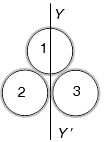
Three rings each of mass $M$ and radius $R$ are arranged as shown in the figure. The moment of inertia of the system about $YY' $ will be 
A body is dropped from a height $H$. The time taken to cover second half of the journey is ............
A total of $48 \mathrm{~J}$ heat is given to one mole of helium kept in a cylinder. The temperature of helium increases by $2^{\circ} \mathrm{C}$. The work done by the gas is : (Given, $\mathrm{R}=8.3 \mathrm{~J} \mathrm{~K}^{-1} \mathrm{~mol}^{-1}$.)
A particle which is constrained to move along the $x-$axis, is subjected to a force in the same direction which varies with the distance $x$ of the particle from the origin as $F(x) = - kx + a{x^3}$. Here k and a are positive constants. For $x \ge 0$, the functional from of the potential energy $U(x)$ of the particle is
A cylinder rolls without slipping down an inclined plane, the number of degrees of freedom it has, is