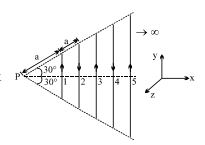
Infinite number of straight wires each carrying current $I$ are equally placed as shown in the figure. Adjacent wires have current in opposite direction. Net magnetic field at point $P$ is
Diffcult
Download our app for free and get started
$\vec{\mathrm{B}}=\left(\mathrm{B}_{1}-\mathrm{B}_{2}+\mathrm{B}_{3}-\mathrm{B}_{4} \ldots \ldots+\infty\right) \hat{\mathrm{k}}$
Here $\quad \mathrm{B}_{1}=\frac{\mu_{0} \mathrm{I}}{4 \pi \mathrm{a}}\left(\sin 30^{\circ}+\sin 30^{\circ}\right)$
$B_{1}=\frac{\mu_{0} I}{4 \pi a \cos 30^{\circ}}\left(\frac{1}{2}+\frac{1}{2}\right)$
$B_{1}=\frac{2 \mu_{0} I}{4 \sqrt{3} \pi a}$
Similarly, $\mathrm{B}_{2}=\frac{2 \mu_{0} \mathrm{I}}{8 \sqrt{3} \pi \mathrm{a}}$ and so on
$\therefore \quad \vec{\mathrm{B}}=\frac{2 \mu_{0} \mathrm{I}}{4 \sqrt{3} \pi \mathrm{a}}\left(1-\frac{1}{2}+\frac{1}{3}-\frac{1}{4} \ldots \ldots+\infty\right)$
$\vec{\mathrm{B}}=\frac{2 \mu_{0} \mathrm{I}}{4 \sqrt{3} \pi \mathrm{a}} \ln 2 \hat{\mathrm{k}}$
$\vec{\mathrm{B}}=\frac{\mu_{0} \mathrm{I}}{4 \sqrt{3} \pi \mathrm{a}} \ln 4 \hat{\mathrm{k}}$

Download our appand get started for free
Experience the future of education. Simply download our apps or reach out to us for more information. Let's shape the future of learning together!No signup needed.*
Similar Questions
- 1Two coaxial solenoids of different radii carry current $I$ in the same direction. Let $\;{\overrightarrow {\;F} _1}$ be the magnetic force on the inner solenoid due to the outer one and $\;{\overrightarrow {\;F} _2}$ be the magnetic force on the outer solenoid due to the inner one. ThenView Solution
- 2View SolutionIf a positive ion is moving, away from an observer with same acceleration, then the lines of force of magnetic induction will be
- 3A triangular loop of side $l$ carries a current $I$. It is placed in a magnetic field $B$ such that the plane of the loop is in the direction of $B$. The torque on the loop isView Solution
- 4Given below are two statements$:$View Solution
Statement $I:$ Biot-Savart's law gives us the expression for the magnetic field strength of an infinitesimal current element (IdI) of a current carrying conductor only.
Statement $II :$ Biot-Savart's law is analogous to Coulomb's inverse square law of charge $q$, with the former being related to the field produced by a scalar source, Idl while the latter being produced by a vector source, $q$. In light of above statements choose the most appropriate answer from the options given below:
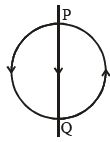
- 5A circular coil of wire carries a current. $PQ$ is a part of a very long wire carrying a current and passing close to the circular coil. If the directions of currents are those shown in figure, what is the direction of force acting on $PQ$ ?View Solution
- 6View SolutionA charged particle moving in a magnetic field experiences a resultant force
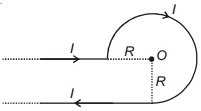
- 7Magnetic field at the centre $O$ due to the given structure isView Solution
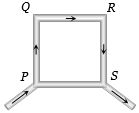
- 8$PQRS$ is a square loop made of uniform conducting wire the current enters the loop at $P$ and leaves at $S$. Then the magnetic field will beView Solution
- 9A particle of mass $m = 1.67 \times 10^{-27}\, kg$ and charge $q = 1.6 \times 10^{-19} \, C$ enters a region of uniform magnetic field of strength $1$ $tesla$ along the direction shown in the figure. the radius of the circular portion of the path is :-View Solution
- 10An electric field of $1500\, V/m$ and a magnetic field of $0.40\, weber/metre^2$ act on a moving electron. The minimum uniform speed along a straight line the electron could have isView Solution