MCQ
Inside a uniform spherical shell

$(a)$ the gravitational field is zero

$(b)$ the gravitational potential is zero

$(c)$ the gravitational field is same everywhere

$(d)$ the gravitation potential is same everywhere

$(e)$ all of the above

Choose the most appropriate answer from the options given below

  • $(a), (c)$ and $(d)$ only
  • B
    $(e)$ only
  • C
    $(a), (b)$ and $(c)$ only
  • D
    $({b}),({c})$ and $({d})$ only

Answer

Correct option: A.
$(a), (c)$ and $(d)$ only
a
Inside a spherical shell, gravitational field is zero and hence potential remains same everywhere

Need a full question paper?

Generate a complete, print-ready paper with questions like this in minutes — across 16+ boards, with answer keys.

Start Generating Free

Similar questions

Two blocks of masses $5 \,kg$ and $2 \,kg$ are connected by a spring of negilible mass and placed on a frictionless horizontal surface. An impulse gives a velocity of $7 \,m / s$ to the heavier block in the direction of the lighter block. The velocity of the centre of mass is ....... $m / s$
A particle moves with constant speed $v$ along a regular hexagon $ABCDEF$ in the same order. Then the magnitude of the average velocity for its motion from $A$ to
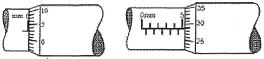
Diagrams show readings of a screw gauge. figure $(i)$ shows the zero error reading when the screw gauge is closed, figure $(ii)$ the reading when the screw gauge is being used to measure the diameter of a ball-bearing. What is the diameter of the ball-bearing in $mm$? There are $50$ divisions on circular scale
Free 238U nuclei kept in a train emit alpha particles. When the train is stationary and a uranium nucleus decays, a passenger measures that the separation between the alpha particles and the recoiling nucleus becomes x, in t time after the decay. If a decay takes places, when the train is moving at a uniform speed v, the distance between the alpha particle and the recoiling nucleus at a time t after the decay, as measured by the passenger will be:  
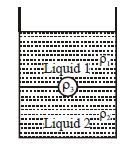
Diagram shows a jar filled with two non mixing liquids $1$ and $2$ having densities ${\rho _1}$ and  ${\rho _2}$  respectively. A solid ball, made of a material of density  ${\rho _3}$ , is dropped in the jar. It comes to equilibrium in the position shown in the figure. Which of the following is true for ${\rho _1}$ ,  ${\rho _2}$ and ${\rho _3}$  ?
In a gravitational field, at a point where the gravitational potential is zero
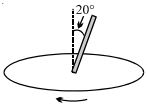
$A$ uniform rod is fixed to a rotating turntable so that its lower end is on the axis of the turntable and it makes an angle of $20^o$ to the vertical. (The rod is thus rotating with uniform angular velocity about a vertical axis passing through one end.) If the turntable is rotating clockwise as seen from above. What is the direction of the rod's angular momentum vector (calculated about its lower end)?
A particle experiences a variable force $\overrightarrow{ F }=\left(4 x \hat{ i }+3 y ^{2} \hat{ j }\right)$ in a horizontal $x - y$ plane. Assume distance in meters and force is newton. If the particle moves from point $(1,2)$ to point $(2,3)$ in the $x-y$ plane, the Kinetic Energy changes by............$j$
In a coaxial, straight cable, the central conductor and the outer conductor carry equal currents in opposite directions. The magnetic field is zero:
  1. Outside the cable.
  2. Inside the inner conductor.
  3. Inside the outer conductor.
  4. In between the tow conductors.
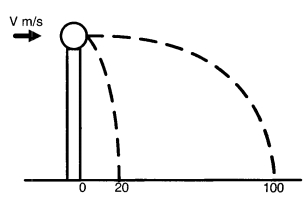
A ball of mass $0.2 \ kg$ rests on a vertical post of height $5 m$. A bullet of mass $0.01 \ kg$, traveling with a velocity $V / s$ in a horizontal direction, hits the centre of the ball. After the collision, the ball and bullet travel independently. The ball hits the ground at a distance of $20 \ m$ and the bullet at a distance of $100 \ m$ from the foot of the post. The initial velocity $V$ of the bullet is