Question
$\int \frac{1}{\sqrt{x^2-8 x-20}} d x$

Answer

$\text { Let } I =\int \frac{1}{\sqrt{x^2-8 x-20}} d x$
$=\int \frac{1}{\sqrt{x^2-2.4 x+16-16-20}} d x$
$=\int \frac{ d x}{\sqrt{(x-4)^2-36}} d x$
$=\int \frac{ d x}{\sqrt{(x-4)^2-6^2}} d x$
$=\log \left|(x-4)+\sqrt{(x-4)^2-6^2}\right|+ c$
$\therefore I =\log \left|(x-4)+\sqrt{x^2-8 x-20}\right|+ c $

Need a full question paper?

Generate a complete, print-ready paper with questions like this in minutes — across 16+ boards, with answer keys.

Start Generating Free

Similar questions

For each of the following differential equations find the particular solution : $\left(x-y^2 x\right) d x-\left(y+x^2 y\right) d y=0$, when $x=2, y=0$.
It is known that, in a certain area of a large city, the average number of rats per bungalow is five. Assuming that the number of rats follows Poisson distribution, find the probability that a randomly selected bungalow has more than 5 rats inclusive. Given $e^{-5}= 0.0067.$
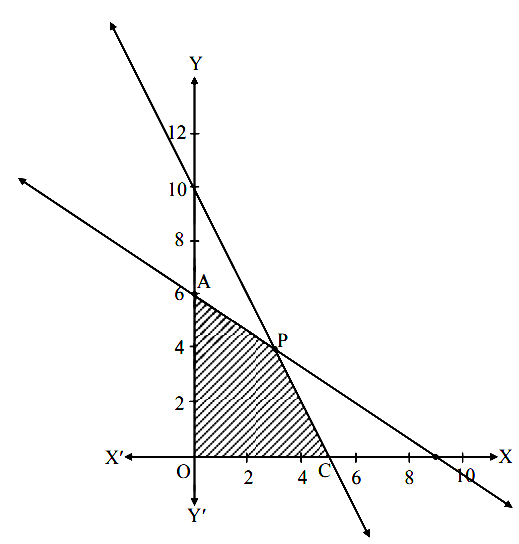
Solve the following LPP graphically:
Maximize Z = 9x + 13y subject to constraints
2x + 3y ≤ 18, 2x + y ≤ 10, x ≥ 0, y ≥ 0

Solution: Convert the constraints into equations and find the intercept made by each one of it.
Inequation Equation X intercept Y intercept Region
2x + 3y ≤ 18 2x + 3y = 18 (9, 0) (0, ___) Towards origin
2x + y ≤ 10 2x + y = 10 ( ___, 0) (0, 10) Towards origin
x ≥ 0, y ≥ 0 x = 0, y = 0 X axis Y axis ______
The feasible region is OAPC, where O(0, 0), A(0, 6),

P( ___, ___ ), C(5, 0)

The optimal solution is in the following table:
Point Coordinates Z = 9x + 13y Values Remark
O (0, 0) 9(0) + 13(0) 0  
A (0, 6) 9(0) + 13(6) ______  
P ( ___,___ ) 9( ___ ) + 13( ___ ) ______ ______
C (5, 0) 9(5) + 13(0) ______  
∴ Z is maximum at __( ___, ___ ) with the value ___.
The probability that a bomb will hit the target is $0.8.$ Using the following activity, find the probability that, out of $5$ bombs, exactly $2$ will miss the target
Solution: Let $p =$ probability that bomb miss the target
$ \therefore q =\square, p =\square, n =5 .$
$X \sim B (5, \square), P ( x )={ }^{ n } C _x P ^x q ^{ n -x}$
$P ( X =2)={ }^5 C _2 \square=\square $
If $\left[\begin{array}{cc}2 a+b & 3 a-b \\ c+2 d & 2 c-d\end{array}\right]=\left[\begin{array}{cc}2 & 3 \\ 4 & -1\end{array}\right]$, find $a , b , c$ and $d$.
Verify that $A(B+C)=A B+A C$, if $A=\left[\begin{array}{cc}4 & -2 \\ 2 & 3\end{array}\right], B=\left[\begin{array}{cc}-1 & 1 \\ 3 & -2\end{array}\right]$ and $C=\left[\begin{array}{cc}4 & 1 \\ 2 & -1\end{array}\right]$
Using the truth table, verify:
(i) p ∨ (q ∧ r) = (p ∨ q) ∧ (p ∨ r)
(ii) p → (p → q) ≡ ~q → (p → q)
(iii) ~(p → ~q) ≡ p ∧ ~(~q) ≡ p ∧ q
(iv) ~(p ∨ q) ∨ (~p ∧ q) ≡ ~p
It is known that, in a certain area of a large city, the average number of rats per bungalow is five. Assuming that the number of rats follows Poisson distribution,
find the probability that a randomly selected bungalow has exactly $5$ rats inclusive. Given $e^{-5}= 0.0067$.
The following data about the sales and advertisement expenditure of a firms is given below (in ₹ crores)
SALESADV.EXP.
MEAN406
S.D.1015
Also correlation coefficient between X and Y is 0.9
(i) Estimate the likely sales for a proposed advertisement expenditure of ₹ 10 crores.
(ii) What should be the advertisement expenditure if the firm proposes a sales target ₹ 60 crores
Let the sales be X and advertisement expenditure be Y
Find the population of city at any time $t$ given that rate of increase of population is proportional to the population at that instant and that in a period of 40 years the population increased from 30000 to 40000 .
Solution: Let $p$ be the population at time $t$.
Then the rate of increase of $p$ is $\frac{d p}{d t}$ which is proportional to $p$.
$\therefore \frac{ dp }{ dt } \propto p$
$\therefore \frac{ dp }{ dt }= kp$, where $k$ is a constant.
$\therefore \frac{ dp }{ p }= kdt$
On integrating, we get
$ \int \frac{ dp }{ p }= k \int dt$
$\therefore \log p = kt + c $
Initially, i.e. when $t=0$, let $p=30000$
$\therefore \log 30000= k \times 0+ c$
$\therefore c =\square$
$\therefore \log p=k t+\log 30000$
$\therefore \log p-\log 30000=k t$
$\therefore \log \left(\frac{ p }{30000}\right)= kt\ldots(i)$
when $t=40, p=40000$
$ \therefore \log \left(\frac{40000}{30000}\right)=40 k$
$\therefore k =\square $
$\therefore$ equation (1) becomes, $\log \left(\frac{p}{30000}\right)=\square$
$\therefore \log \left(\frac{ p }{30000}\right)=\frac{ t }{40} \log \left(\frac{4}{3}\right)$
$\therefore p=\square$