MCQ
$\int {\frac{{1 - {x^7}}}{{x\left( {1 + {x^7}} \right)}}} \,dx$ equals
  • A
    $\ln \,x\, + \,\frac{2}{7}\ \ln \left( {1 + {x^7}} \right) + c$
  • B
    $\ln \,x\, - \,\frac{2}{7}\ \ln \left( {1 - {x^7}} \right) + c$
  • $\ln \,x\, - \,\frac{2}{7}\ \ln \left( {1 + {x^7}} \right) + c$
  • D
    $\ln \,x\, + \,\frac{2}{7}\ \ln \left( {1 - {x^7}} \right) + c$

Answer

Correct option: C.
$\ln \,x\, - \,\frac{2}{7}\ \ln \left( {1 + {x^7}} \right) + c$
c
${\rm{I}} = \int {\frac{{{\rm{dx}}}}{{\rm{x}}}}  - \int {\frac{{2{{\rm{x}}^6}}}{{1 + {{\rm{x}}^7}}}} {\rm{dx}}$

Need a full question paper?

Generate a complete, print-ready paper with questions like this in minutes — across 16+ boards, with answer keys.

Start Generating Free

Similar questions

$\text{A}^2=\text{I}\Rightarrow$
  1. $|\text{A}|=0$
  2. $|\text{A}|=1$
  3. $|\text{A}|=-1$
  4. $|\text{A}|=\pm1$
What is $ \tan ^{ -1 }{ \left( \frac { 1 }{ 2 } \right) } +\tan ^{ -1 }{ \left( \frac { 1 }{ 3 } \right) }$equal to?
  1. $ \frac { \pi }{ 3 }$
  2. $ \frac { \pi }{ 4 }$
  3. $ \frac { \pi }{ 6 }$
  4. $ \frac { \pi }{ 9 }$
If the volume of a parallelopiped, whose coterminus edges are given by the vectors

$\overrightarrow{ a }=\hat{ i }+\hat{ j }+ n \hat{ k }, \quad \overrightarrow{ b }=2 \hat{ i }+4 \hat{ j }- n \hat{ k } \quad$ and $\overrightarrow{ c }=\hat{ i }+ n \hat{ j }+3 \hat{ k } \quad( n \geq 0),$ is $158 cu. Units$, then

The straight line $\frac{\text{x}-3}{3}=\frac{\text{y}-2}{1}=\frac{\text{z}-1}{0}$ is:
lf $\text{AB}\perp\text{BC}$ then the value of $\lambda$ equal, where A(2k, 2, 3), B(k, 1, 5), C(3 + k, 2, 1):
  1. $3$
  2. $\frac{1}{3}$
  3. $-3$
  4. $-\frac{1}{3}$
If $f(x) = \sin x - \cos x,$ the function decreasing in $0 \le x \le 2\pi $ is
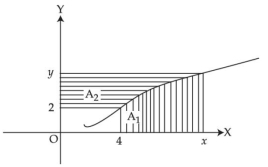
Consider a curve $y=y(x)$ in the first quadrant as shown in the figure. Let the area $A_{1}$ is twice the area $A _{2}$. Then the normal to the curve perpendicular to the line $2 x -12 y =15$ does NOT pass through the point.
If A is a square matrix, then AA is a:
  1. Skew-symmetric matrix.
  2. Symmetric matrix.
  3. Diagonal matrix.
  4. None of these.
If ${a^2} + {b^2} + {c^2} + ab + bc + ca \leq 0\,\forall a,\,b,\,c\, \in \,R$ , then the value of determinant $\left| {\begin{array}{*{20}{c}}
  {{{(a + b + c)}^2}}&{{a^2} + {b^2}}&1 \\ 
  1&{{{(b + c + 2)}^2}}&{{b^2} + {c^2}} \\ 
  {{c^2} + {a^2}}&1&{{{(c + a + 2)}^2}} 
\end{array}} \right|$ 
Let $\alpha$ be a root of the equation $x^{2}+x+1=0$ and the matrix $A=\frac{1}{\sqrt{3}}\left[\begin{array}{ccc}{1} & {1} & {1} \\ {1} & {\alpha} & {\alpha^{2}} \\ {1} & {\alpha^{2}} & {\alpha^{4}}\end{array}\right],$ then the matrix $\mathrm{A}^{31}$ is equal to