Question
$\int \frac{1+\tan x}{1-\tan x} d x$ is equal to:

Answer

(d) $\log \left|\sec \left(\frac{x}{4}+x\right)\right|+C$
Explanation: $\log \left|\sec \left(\frac{x}{4}+x\right)\right|+C$

Need a full question paper?

Generate a complete, print-ready paper with questions like this in minutes — across 16+ boards, with answer keys.
Start Generating Free

Similar questions

Determinant $\left|\begin{array}{cc}1 & \log _b a \\ \log _a b & 1\end{array}\right|=$
If A is a square matrix, then AA is a:
  1. Skew-symmetric matrix.
  2. Symmetric matrix.
  3. Diagonal matrix.
  4. None of these.
If $\text{A}=\begin{bmatrix}1&2&\text{x}\\0&1&0\\0&0&1\end{bmatrix}$ and $\text{B}=\begin{bmatrix}1&-2&\text{y}\\0&1&0\\0&0&1\end{bmatrix}$ and $AB = I_3, $ then $x + y$ equals:
The maximum value of Z = 4x + 3y subjected to the constraints 3x + 2y ≥ 160, 5x + 2y ≥ 200, x + 2y ≥ 80, x, y ≥ 0 is:
A letter is known to have come either from $\text{LONDON}$ or $\text{CLIFTON}$; on the postmark only the two consecutive letters $\text{ON}$ are ellegible. The probability that it came from $\text{LONDON}$ is:
If the corner points of the feasible region of an LPP are $(0,3),(3,2)$ and $(0,5)$, then the minimum value of $Z=11 x+7 y$ is
Choose the correct answer from the given four options.
$A$ and $B$ are two students. Their chances of solving a problem correctly are $\frac{1}{3}$ and $\frac{1}{4},$respectively. If the probability of their making a common error is, $\frac{1}{20}$ and they obtain the same answer, then the probability of their answer to be correct is:
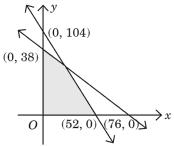
The feasible region of an LPP is given in the following figure
Image
Then, the constraints of the LPP are $x \geq 0, y \geq 0$ and
The value of $ \left( {{{\tan }^{ - 1}}\pi + {{\tan }^{ - 1}}\left( {\frac{1}{\pi }} \right)} \right) + {\tan ^{ - 1}}\sqrt 3 - {\sec ^{ - 1}}( - 2)$ is equal to
  1. $ \frac{{ - \pi }}{3}$
  2. $ \frac{{ \pi }}{6}$
  3. $ \frac{{ 2 \pi }}{3}$
  4. $ \pi$
$\int\limits^{\frac{\pi}{2}}_0\sin2\text{x }\log\tan\text{x dx}$ is equal to:
  1. $\pi$
  2. $\frac{\pi}{2}$
  3. $0$
  4. $2\pi$