MCQ
$\int_{}^{} {\frac{{dx}}{{(1 + {x^2})\sqrt {1 - {x^2}} }} = } $
  • A
    $\frac{1}{{\sqrt 2 }}{\tan ^{ - 1}}\left[ {\frac{{\sqrt {1 - {x^2}} }}{{x\sqrt 2 }}} \right] + c$
  • $\frac{1}{{\sqrt 2 }}{\tan ^{ - 1}}\left[ {\frac{{x\sqrt 2 }}{{\sqrt {1 - {x^2}} }}} \right] + c$
  • C
    $\sqrt 2 {\tan ^{ - 1}}\left[ {\frac{{\sqrt {1 - {x^2}} }}{{x\sqrt 2 }}} \right] + c$
  • D
    $ - \sqrt 2 {\tan ^{ - 1}}\left[ {\frac{{\sqrt {1 - {x^2}} }}{{x\sqrt 2 }}} \right] + c$

Answer

Correct option: B.
$\frac{1}{{\sqrt 2 }}{\tan ^{ - 1}}\left[ {\frac{{x\sqrt 2 }}{{\sqrt {1 - {x^2}} }}} \right] + c$
b
(b) Put $x = \sin \theta \Rightarrow dx = \cos \theta \,d\theta ,$ then
$\int_{}^{} {\frac{{dx}}{{(1 + {x^2})\sqrt {1 - {x^2}} }} = \int_{}^{} {\frac{1}{{1 + {{\sin }^2}\theta }}\,d\theta } } = \int_{}^{} {\frac{{{{\sec }^2}\theta }}{{1 + 2{{\tan }^2}\theta }}\,d\theta } $
Again put $t = \tan \theta \Rightarrow dt = {\sec ^2}\theta \,d\theta ,$ then it reduces to
$\int_{}^{} {\frac{1}{{1 + 2{t^2}}}\,dt} = \frac{1}{2}\int_{}^{} {\frac{1}{{{t^2} + {{\left( {\frac{1}{{\sqrt 2 }}} \right)}^2}}}\,dt} $
$ = \frac{1}{2}\left( {\frac{1}{{(1/\sqrt 2 )}}} \right){\tan ^{ - 1}}\left( {\frac{t}{{(1/\sqrt 2 )}}} \right) + c$
$ = \frac{1}{{\sqrt 2 }}{\tan ^{ - 1}}(\sqrt 2 \tan \theta ) + c = \frac{1}{{\sqrt 2 }}{\tan ^{ - 1}}\left( {\frac{{x\sqrt 2 }}{{\sqrt {1 - {x^2}} }}} \right) + c.$
Aliter : Put first $x = \frac{1}{t}$ and then ${t^2} - 1 = {z^2}.$

Need a full question paper?

Generate a complete, print-ready paper with questions like this in minutes — across 16+ boards, with answer keys.

Start Generating Free

Similar questions

If all the words with or without meaning made using all the letters of the word $" \text{NAGPUR}"$ are arranged as in a dictionary, then the word at $315^{th}$ position in this arrangement is :
The Coefficient of $x ^{-6}$, in the expansion of $\left(\frac{4 x}{5}+\frac{5}{2 x^2}\right)^9$, is $........$.
If $P $ and  $ Q $ be the middle points of the sides $BC$  and $ CD$  of the parallelogram $ABCD$ , then $\overrightarrow {AP} + \overrightarrow {AQ} = $
For $n > 0,$ $\int_0^{2\pi } {\frac{{x{{\sin }^{2n}}x}}{{{{\sin }^{2n}}x + {{\cos }^{2n}}x}}\,dx = } $
The differential equation $\frac{{{d^2}y}}{{d{x^2}}} + x\frac{{dy}}{{dx}} + \sin y + {x^2} = 0$ is of the following type
In a tournament, a team plays $10$ matches with probabilities of winning and losing each match as $\frac{1}{3}$ and $\frac{2}{3}$ respectively. Let $x$ be the number of matches that the team wins, and $y$ be the number of matches that team loses. If the probability $\mathrm{P}(|\mathrm{x}-\mathrm{y}| \leq 2)$ is $\mathrm{p}$, then $3^9 \mathrm{p}$ equals....................
If $p$ times the ${p^{th}}$ term of an $A.P.$ is equal to $q$ times the ${q^{th}}$ term of an $A.P.$, then ${(p + q)^{th}}$ term is
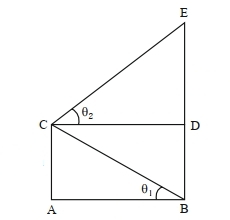
In the figure, $\theta_1+\theta_2=\frac{\pi}{2}$ and $\sqrt{3}(B E)=4(A B)$. If the area of $\triangle CAB$ is $2 \sqrt{3}-3$ unit $^2$, when $\frac{\theta_2}{\theta_1}$ is the largest, then the perimeter (in unit) of $\triangle CED$ is equal to $...........$.
Which is the correct order for a given number $\alpha $in increasing order
The parabola $y^2 = x$ divides the circle $x^2 + y^2 = 2$ into two parts whose areas are in the ratio