MCQ
$\int_{}^{} {\frac{{{{\sec }^2}x\;dx}}{{\sqrt {{{\tan }^2}x + 4} }} = } $
  • $\log \left[ {\tan x + \sqrt {{{\tan }^2}x + 4} } \right] + c$
  • B
    $\frac{1}{2}\log \left[ {\tan x + \sqrt {{{\tan }^2}x + 4} } \right] + c$
  • C
    $\log \left[ {\frac{1}{2}\tan x + \frac{1}{2}\sqrt {{{\tan }^2}x + 4} } \right] + c$
  • D
    None of these

Answer

Correct option: A.
$\log \left[ {\tan x + \sqrt {{{\tan }^2}x + 4} } \right] + c$
a
(a) Put $t = \tan x \Rightarrow dt = {\sec ^2}x\,dx,$ then
$\int_{}^{} {\frac{{{{\sec }^2}x\,dx}}{{\sqrt {{{\tan }^2}x + 4} }}} = \int_{}^{} {\frac{1}{{\sqrt {{t^2} + {2^2}} }}} \,dt$
$ = \log [\tan x + \sqrt {{{\tan }^2}x + 4} ] + c.$

Need a full question paper?

Generate a complete, print-ready paper with questions like this in minutes — across 16+ boards, with answer keys.

Start Generating Free

Similar questions

If $5{x^2} + \lambda {y^2} = 20$ represents a rectangular hyperbola, then $\lambda $ equals
The sum $1+3+11+25+45+71+.$. upto 20 terms, is equal to
Three lines

$L _1: \overrightarrow{ r }=\lambda \hat{ i }, \lambda \in R ,$

$L _2: \overrightarrow{ r }=\hat{ k }+\mu \hat{ j }, \mu \in R \text { and }$

$L _3: \overrightarrow{ r }=\hat{ i }+\hat{ j }+ vk , v \in R$

are given. For which point(s) $Q$ on $L_2$ can we find a point $P$ on $L_1$ and a point $R$ on $L_3$ so that $P$, $Q$ and $R$ are collinear?

$(1)$ $\hat{k}+\hat{j}$ $(2)$ $\hat{ k }$ $(3)$ $\hat{ k }+\frac{1}{2} \hat{ j }$ $(4)$ $\hat{k}-\frac{1}{2} \hat{j}$

If function $f(x) = \left\{ \begin{array}{l}\frac{{{x^2} - 1}}{{x - 1}},\,\,{\rm{when}}\,\,x \ne 1\\\,\,\,\,\,\,\,\,\,\,\,\,k,\,{\rm{when}}\,\,x = 1\end{array} \right.$ is continuous at $x = 1$, then the value of $k$ will be
The points of trisection of the line segment joining the points $(3, -2)$ and $(-3, -4)$ are
If three distinct number $a, b, c$ are in $G.P.$ and the equations $ax^2 + 2bc + c = 0$ and $dx^2 + 2ex + f = 0$ have a common root, then which one of the following statements is correct?
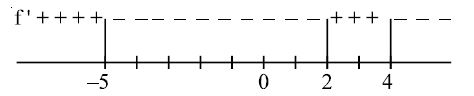
 $(i)$  $f (x)$ is continuous and defined for all real numbers

$(ii)$ $f '(-5) = 0 \,; \,f '(2)$ is not defined and $f '(4)  = 0$

$(iii)$ $(-5, 12)$ is a point which lies on the graph of $f (x)$

$(iv)$ $f ''(2)$ is undefined, but $f ''(x)$ is negative everywhere else.

$(v)$ the signs of  $f '(x)$ is given below

Possible graph of $y = f (x)$ is

In a box containing $100$ eggs, $10$ eggs are rotten. The probability that out of a sample of $5$ eggs none is rotten if the sampling is with replacement is
If $f(x) = \log \frac{{1 + x}}{{1 - x}}$, then $f(x)$ is
The value of the definite integral, $\int\limits_0^{100} {\frac{x}{{{e^{{x^2}}}}}\,dx} $ is equal to