MCQ
$\int {\frac{{{{\sin }^3}2x}}{{{{\cos }^5}2x}}dx = } $
  • A
    ${\tan ^4}x + C$
  • B
    $\tan 4x + C$
  • C
    ${\tan ^4}2x + x + C$
  • $\frac{1}{8}{\tan ^4}2x + C$

Answer

Correct option: D.
$\frac{1}{8}{\tan ^4}2x + C$
d
(d) $I = \int {\frac{{{{\sin }^3}2x}}{{{{\cos }^5}2x}}dx} $
==> $I = \int {\frac{{{{\sin }^3}2x}}{{{{\cos }^3}2x}}.\frac{1}{{{{\cos }^2}2x}}dx = \int {{{\tan }^3}2x.{{\sec }^2}2x\,dx.} } $
Putting tan $2x = t$ and $2{\sec ^2}2x\,dx = dt$, we get
$I = \int {{t^3}\frac{{dt}}{2} = \frac{1}{2}.\frac{{{t^4}}}{4} + C = \frac{1}{8}({{\tan }^4}2x) + C.} $

Need a full question paper?

Generate a complete, print-ready paper with questions like this in minutes — across 16+ boards, with answer keys.
Start Generating Free

Similar questions

What is the length of the longer diagonal of the parallelogram constructed on $5\vec{\text{a}}+2\vec{\text{b}}$ and $\vec{\text{a}}-3\vec{\text{b}}$ if it is given that $|\vec{\text{a}}|=2\sqrt{2},\big|\vec{\text{b}}\big|=3$ and the angle between $\vec{\text{a}}$ and $\vec{\text{b}}$ is $\frac{\pi}{4}$?
  1. $15$
  2. $\sqrt{113}$
  3. $\sqrt{593}$
  4. $\sqrt{369}$
Let $\mathrm{f}: \mathrm{R}-\left\{\frac{-1}{2}\right\} \rightarrow \mathrm{R}$ and $\mathrm{g}: \mathrm{R}-\left\{\frac{-5}{2}\right\} \rightarrow \mathrm{R}$ be defined as $f(x)=\frac{2 x+3}{2 x+1}$ and $g(x)=\frac{|x|+1}{2 x+5}$. Then the domain of the function $fog$ is:
Find the degree of the differential equation:
$\Big(1+\frac{\text{dx}}{\text{dy}}\Big)^3=\Big(\frac{\text{dy}}{\text{dx}}\Big)^2$
  1. 0
  2. 1
  3. 2
  4. 3
Which of the following equation is non-linear
$P$ is a point on the line joining the points $A(0,5,-2)$ and $B(3,-1,2)$. If the $x$-coordinate of $P$ is 6 , then its $z$-coordinate is
Let $\mathrm{f}: \mathbb{R} \rightarrow \mathbb{R}$ be a thrice differentiable function such that $f(0)=0, f(1)=1, f(2)=-1, f(3)=2$ and $f(4)=-2$. Then, the minimum number of zeros of $\left(3 f^{\prime} f^{\prime \prime}+f f^{\prime \prime \prime}\right)(x)$ is....................
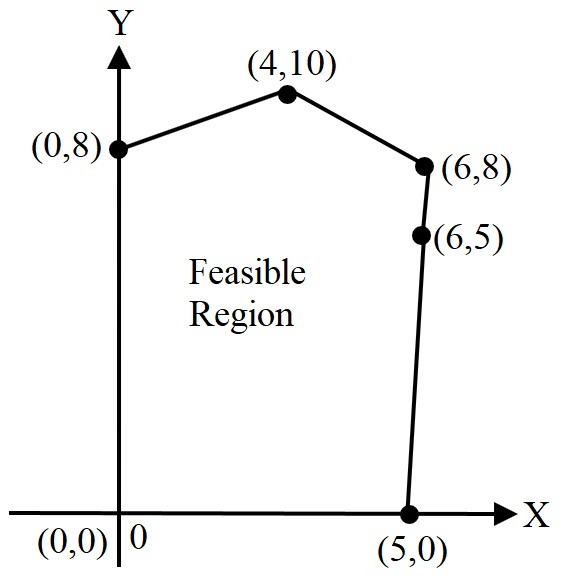
The feasible, region for an LPP is shown shaded in the figure. Let Z = 3x - 4y be the objective function. A minimum of Z occurs at:

  1. (0, 0)
  2. (0, 8)
  3. (5, 0)
  4. (4, 10)
Water is drained from a vertical cylindrical tank by opening a valve at the base of the tank. It is known that the rate at which the water level drops is proportional to the square root of water depth $y,$ where the constant of proportionality $k > 0$ depends on the acceleration due to gravity and the geometry of the hole. If t is measured in minutes and $k = \frac{1}{{15}}$ then the time to drain the tank if the water is $4$ meter deep to start with is ......... $\min.$
If ${\tan ^{ - 1}}x + {\cos ^{ - 1}}\frac{y}{{\sqrt {(1 + {y^2})} }} = {\sin ^{ - 1}}\frac{3}{{\sqrt {10} }}$ and both $x$ and $y$ are positive and integral, then $x$ and $y =$
The probability that a bulb produced by a factory will fuse after $150$ days of use is $0.05$. What is the probability that out of $5$ such bulbs none will fuse after $150$ days of use