MCQ
$\int_{}^{} {\frac{{{x^{e - 1}} + {e^{x - 1}}}}{{{x^e} + {e^x}}}dx = } $
  • A
    $\log ({x^e} + {e^x}) + c$
  • B
    $e\log ({x^e} + {e^x}) + c$
  • $\frac{1}{e}\log ({x^e} + {e^x}) + c$
  • D
    None of these

Answer

Correct option: C.
$\frac{1}{e}\log ({x^e} + {e^x}) + c$
c
(c) Put ${x^e} + {e^x} = t \Rightarrow e({x^{e - 1}} + {e^{x - 1}})\,dx = dt,$
$\int_{}^{} {\frac{{{x^{e - 1}} + {e^{x - 1}}}}{{{x^e} + {e^x}}}} \,dx = \frac{1}{e}\int_{}^{} {\frac{{dt}}{t}} = \frac{1}{e}\log t = \frac{1}{e}\log ({x^e} + {e^x}) + c$.

Need a full question paper?

Generate a complete, print-ready paper with questions like this in minutes — across 16+ boards, with answer keys.

Start Generating Free

Similar questions

The equation of the ellipse whose one focus is at $(4, 0)$ and whose eccentricity is $4/5$, is
The function $f(x) = {x^3} - 6{x^2} + ax + b$ satisfy the conditions of Rolle's theorem in $[1, 3]. $ The values of  $a $ and $ b $ are
If $p = \frac{{b \times c}}{{[a\,b\,c]}},\,\,q = \frac{{c \times a}}{{[a\,b\,c]}},\,\,r = \frac{{a \times b}}{{[a\,b\,c]}},\,\,$where $a, b, c $ are three non-coplanar vectors, then the value of $(a + b + c)\,.\,(p + q + r)$ is given by
Let $A=\{-4,-3,-2,0,1,3,4\}$ and $R =\{( a , b ) \in A$ $\times A : b =| a |$ or $\left.b ^2= a +1\right\}$ be a relation on $A$. Then the minimum number of elements, that must be added to the relation $R$ so that it becomes reflexive and symmetric, is $........$.
Let $a$ and $b$ be positive real numbers such that $a > 1$ and $b < a$. Let $P$ be a point in the first quadrant that lies on the hyperbola $\frac{ x ^2}{ a ^2}-\frac{ y ^2}{ b ^2}=1$. Suppose the tangent to the hyperbola at $P$ passes through the point $(1,0)$, and suppose the normal to the hyperbola at $P$ cuts off equal intercepts on the coordinate axes. Let $\Delta$ denote the area of the triangle formed by the tangent at $P$, the normal at $P$ and the $x$-axis. If $e$ denotes the eccentricity of the hyperbola, then which of the following statements is/are $TRUE$?

$(A)$ $1 < e < \sqrt{2}$

$(B)$ $\sqrt{2} < e < 2$

$(C)$ $\Delta=a^4$

$(D)$ $\Delta=b^4$
The number of integral solutions $x$ of $\log _{\left(x+\frac{7}{2}\right)}\left(\frac{x-7}{2 x-3}\right)^2 \geq 0$ is
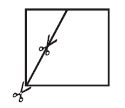
Consider a square of side $2\ cm$ . It is cut from one of its corner as shown in adjacent figure. Maximum value of sum of the perimeters of two plane figures thus formed is
If $A = {\tan ^{ - 1}}x$, then $\sin 2A = $
An ellipse is inscribed in a circle and a point is inside a circle is choosen at random. If the probability that this point lies outside the ellipse is $\frac {2}{3}$ then eccentricity of ellipse is $\frac{{a\sqrt b }}{c}$ . Where $gcd( a, c) = 1$ and $b$ is square free integer ($b$ is not divisible by square of any integer except $1$ ) then $a · b · c$ is
If $\overrightarrow x  = 3\hat i - 6\hat j - \hat k$ , $\overrightarrow y  = \hat i + 4\hat j - 3\hat k$ and $\,\,\overrightarrow z  = 3\hat i - 4\hat j - 12\hat k$ , then the magnitude of the projection of $\overrightarrow x  \times \overrightarrow y $ on $\overrightarrow z$ is