MCQ
$\int_{}^{} {{{\left( {x + \frac{1}{x}} \right)}^3}} dx = $
  • A
    $\frac{1}{4}{\left( {x + \frac{1}{x}} \right)^4} + c$
  • $\frac{{{x^4}}}{4} + \frac{{3{x^2}}}{2} + 3\log x - \frac{1}{{2{x^2}}} + c$
  • C
    $\frac{{{x^4}}}{4} + \frac{{3{x^2}}}{2} + 3\log x + \frac{1}{{{x^2}}} + c$
  • D
    None of these

Answer

Correct option: B.
$\frac{{{x^4}}}{4} + \frac{{3{x^2}}}{2} + 3\log x - \frac{1}{{2{x^2}}} + c$
b
(b) $\int_{}^{} {{{\left( {x + \frac{1}{x}} \right)}^3}dx = \int_{}^{} {\left( {{x^3} + \frac{1}{{{x^3}}} + 3x + \frac{3}{x}} \right)\,dx} } $
$ = \frac{{{x^4}}}{4} - \frac{1}{{2{x^2}}} + \frac{{3{x^2}}}{2} + 3\log x + c$
$ = \frac{{{x^4}}}{4} + \frac{{3{x^2}}}{2} + 3\log x - \frac{1}{{2{x^2}}} + c.$

Need a full question paper?

Generate a complete, print-ready paper with questions like this in minutes — across 16+ boards, with answer keys.

Start Generating Free

Similar questions

If $z$ is a complex number, then $(\overline {{z^{ - 1}}} )(\overline z ) = $
Let $I_n=\int_0^{\pi / 2} x^n \cos x d x$, where $n$ is a non-negative integer. Then, $\sum \limits_{n=2}^{\infty}\left(\frac{I_n}{n !}+\frac{I_n-2}{(n-2) !}\right)$ equals
The sum of first $n$ terms of the given series ${1^2} + {2.2^2} + {3^2} + {2.4^2} + {5^2} + {2.6^2} + ............$ is $\frac{{n{{(n + 1)}^2}}}{2}$, when $n$ is even. When $n$ is odd, the sum will be
The line $lx + my - n = 0$ will be tangent to the ellipse $\frac{{{x^2}}}{{{a^2}}} + \frac{{{y^2}}}{{{b^2}}} = 1$, if
$P$ is a variable point on the ellipse $\frac{{{x^2}}}{{{a^2}}} + \frac{{{y^2}}}{{{b^2}}} = 1$ with $AA'$ as the major axis. Then the maximum value of the area of $\Delta APA'$ is
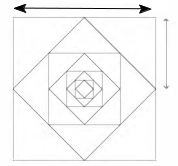
Let $S_1$ be the sum of areas of the squares whose sides are parallel to coordinate axes. Let $S_2$ be the sum of areas of the slanted squares as shown in the figure. Then, $\frac{S_1}{S_2}$ is equal to
A straight line $(\sqrt 3 - 1)x = (\sqrt 3 + 1)y$ makes an angle ${75^o}$with another straight line which passes through origin. Then the equation of the line is
If ${a_1},{a_2},....{a_n}$ are positive real numbers whose product is a fixed number $c$, then the minimum value of ${a_1} + {a_2} + ...$ $ + {a_{n - 1}} + 2{a_n}$ is
The area enclosed by the curve $y={{\sin }^{-1}}\left( \cos x \right)$ and $y={{\cos }^{-1}}\left( \sin x \right)$ for $x\in \left[ \frac{\pi }{2},\frac{3\pi }{2} \right]$, is
The number of solutions of the equation $\sin (9 x)+\sin (3 x)=0$ in the closed interval $[0,2 \pi]$ is