MCQ
$\int_{}^{} {{{\sin }^3}x\;.\;\cos x\;dx = } $
  • A
    $\frac{{{{\sin }^4}x{{\cos }^2}x}}{8} + c$
  • $\frac{{{{\sin }^4}x}}{4} + c$
  • C
    $\frac{{{{\sin }^2}x}}{2} + c$
  • D
    $4{\sin ^4}x + c$

Answer

Correct option: B.
$\frac{{{{\sin }^4}x}}{4} + c$
b
(b)$\int_{}^{} {{{\sin }^3}x\,.\,\cos x\,dx} $. Put $\sin x = t,$ then
$\cos x\,dx = dt$; $\int_{}^{} {{t^3}dt} = \frac{{{t^4}}}{4} = \frac{{{{\sin }^4}x}}{4} + c$.

Need a full question paper?

Generate a complete, print-ready paper with questions like this in minutes — across 16+ boards, with answer keys.
Start Generating Free

Similar questions

If $P = \left( {\begin{array}{*{20}{c}}i&0&{ - i}\\0&{ - i}&i\\{ - i}&i&0\end{array}} \right)$ and $Q = \left( {\begin{array}{*{20}{c}}{ - i}&i\\0&0\\i&{ - i}\end{array}} \right)$,then $PQ$ is equal to
If $f(x) f(y)=f(x+y)$ for all $x, y$; suppose $f(5)=2$ and $f^{\prime}(0)=3$, then $f^{\prime}(5)$ is equal to
If direction ratios of two lines are $5,\,\, - 12,\,13$ and $ - 3,\,4,\,5$ then the angle between them is
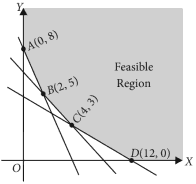
Feasible region for an L.P.P. is shown shaded in the following figure. Minimum of $Z=5 x+3 y$ occurs at the point point
Image
The differential equation whose solution is $A{x^2} + B{y^2} = 1$ where $A$ and $B$ are arbitrary constants is of
Let $a_{n}=\int_{-1}^{n}\left(1+\frac{x}{2}+\frac{x^{2}}{2}+\frac{x^{3}}{3}+\ldots \ldots .+\frac{x^{n-1}}{n}\right) d x$ for $n \in N$. Then the sum of all the elements of the set $\left\{n \in N: a_{n} \in(2,30)\right\}$ is $...........$
If S is the samle space and $\text{P(A)}=\frac{1}{3}, \text{P(B)}$ and $\text{S}=\text{A}\cup\text{B,}$ where A and B are tow mutually exclusive events, then P(A) =
  1. $\frac{1}{4}$
  2. $\frac{1}{2}$
  3. $\frac{3}{4}$
  4. $\frac{3}{8}$
If $f (x) = |x| + |x - 1| + |x - 2|$, $x \in R$ then $\int\limits_0^3 {{\rm{f}}(x)\,dx} $ $=$
If a straight line $y - x = 2$ divides the region ${x^2} + {y^2} \le 4$ into two parts , then the ratio of the area of the smaller part to the area of the greater part is
Let $\hat{a}$ and $\hat{b}$ be two unit vectors such that the angle between them is $\frac{\pi}{4}$. If $\theta$ is the angle between the vectors $(\hat{a}+\hat{b})$ and $(\hat{a}+2 \hat{b}+2(\hat{a} \times \hat{b}))$ then the value of $164 \cos ^{2} \theta$ is equal to.