Question
$\int \frac{x^2}{\left(x^2+1\right)\left(x^2-2\right)\left(x^2+3\right)} d x$

Answer

$\text { Let } I =\int \frac{x^2}{\left(x^2+1\right)\left(x^2-2\right)\left(x^2+3\right)} d x$
Let $\frac{x^2}{\left(x^2+1\right)\left(x^2-2\right)\left(x^2+3\right)}$
$ =\frac{A}{x^2+1}+\frac{b}{x^2-2}+\frac{c}{x^2+3}$
$\therefore x^2=A\left(x^2-2\right)\left(x^2+3\right)+B\left(x^2+1\right)\left(x^2+3\right)+C\left(x^2+1\right)\left(x^2-2\right)\ldots(i) $
Putting $x^2=2$ in (i), we get
$ 2=B \times 3 \times 5$
$\therefore B=\frac{2}{15} $
Putting $x^2=-3$ in (i), we get
$ -3=C \times(-2) \times(-5)$
$\therefore C=\frac{-3}{10} $
Putting $x^2=-1$ in (i), we get
$ -1=A \times(-3) \times 2$
$\therefore A=\frac{1}{6} $
$\therefore \frac{x^2}{\left(x^2+1\right)\left(x^2-2\right)\left(x^2+3\right)}=\frac{\frac{1}{6}}{x^2+1}+\frac{\frac{2}{15}}{x^2-2}+\frac{\frac{-3}{10}}{x^2+3}$
$\therefore I =\int\left[\frac{1}{6\left(x^2+1\right)}+\frac{2}{15\left(x^2-2\right)}-\frac{3}{10\left(x^2+3\right)}\right] d x$
$=\frac{1}{6} \int \frac{1}{x^2+1} d x+\frac{2}{15} \int \frac{1}{x^2-2} d x-\frac{3}{10} \int \frac{1}{x^2+3} d x$
$=\frac{1}{6} \int \frac{1}{x^2+1} d x+\frac{2}{15} \int \frac{1}{x^2-(\sqrt{2})^2} d x-\frac{3}{10} \int \frac{1}{x^2+(\sqrt{3})^2} d x$
$=\frac{1}{6} \tan ^{-1} x+\frac{2}{15} \times \frac{1}{2 \times \sqrt{2}} \log \left|\frac{x-\sqrt{2}}{x+\sqrt{2}}\right|-\frac{3}{10} \times \frac{1}{\sqrt{3}} \tan ^{-1}\left(\frac{x}{\sqrt{3}}\right)+ c$
$\therefore I =\frac{1}{6} \tan ^{-1} x+\frac{1}{15 \sqrt{2}} \log \left|\frac{x-\sqrt{2}}{x+\sqrt{2}}\right|-\frac{\sqrt{3}}{10} \tan ^{-1}\left(\frac{x}{\sqrt{3}}\right)+ c $

Need a full question paper?

Generate a complete, print-ready paper with questions like this in minutes — across 16+ boards, with answer keys.

Start Generating Free

Similar questions

Prove that the product of lengths of perpendiculars drawn from $P\left(x_1, y_1\right)$ to the lines

repersented by $a x^2+2 h x y+b y^2=0$ is $\left|\frac{a x_1^2+2 h x_1 y_1+b y_1^2}{\sqrt{(a-b)^2+4 h^2}}\right|$
The rate of growth of the population of a city at any time t is proportional to the size of the population. For a certain city, it is found that the constant of proportionality is 0.04. Find the population of the city after 25 years, if the initial population is 10,000. [Take e = 2.7182]
Prove that: $\int \frac{d x}{\sqrt{x^2+a^2}}=\log \left|x+\sqrt{x^2+a^2}\right|+c$
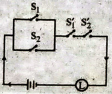
Find the symbolic form of the glven switching circuit. Construct its switching table and interpret your result.
Image
The rate of growth of bacteria is proportional to the number present. If initially, there were 1000 bacteria and the number doubles in 1 hour, find the number of bacteria after $2 \frac{1}{2}$ hours. [Take $\sqrt{2}=1.414$ ]
Differentiate the following w.r.t. x:

$\frac{\left(x^2+2 x+2\right)^{\frac{3}{2}}}{(\sqrt{x}+3)^3(\cos x)^x}$

Write the converse, inverse, and contrapositive of the following statement.

"If it snows, then they do not drive the car"

Find the area of the ellipse:
$\frac{x^2}{a^2}+\frac{y^2}{b^2}=1$
Hence write the area of
$\frac{x^2}{25}+\frac{y^2}{16}=1$
In $\triangle A B C$, prove that $\frac{ a ^2 \sin ( B - C )}{\sin A }+\frac{ b ^2 \sin ( C - A )}{\sin B }+\frac{ c ^2 \sin ( A - B )}{\sin C }$
Integrate the following functions w.r.t. x:

$(x+1) \sqrt{2 x^2+3}$