MCQ
$\int_0^1 {{{(1 - x)}^9}dx = } $
  • A
    $1$
  • $\frac{1}{{10}}$
  • C
    $\frac{{11}}{{10}}$
  • D
    $2$

Answer

Correct option: B.
$\frac{1}{{10}}$
b
(b) Required value =$\left[ {\frac{{ - {{(1 - x)}^{10}}}}{{10}}} \right]_0^1 = \frac{1}{{10}}$.

Need a full question paper?

Generate a complete, print-ready paper with questions like this in minutes — across 16+ boards, with answer keys.
Start Generating Free

Similar questions

If $\omega$ is one of the imaginary cube roots of unity, then the value of the determinant $\left| {\begin{array}{*{20}{c}}1&{{\omega ^3}}&{{\omega ^2}}\\ {{\omega ^3}}&1&\omega \\{{\omega ^2}}&\omega &1\end{array}} \right|$ $=$
$\cot^{-1}(1) + \cot^{-1} (\frac{1}{2}) + \cot^{-1}(\frac{1}{3}) =$
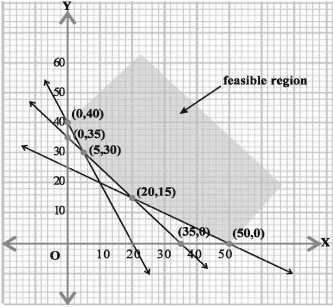
The following graph represents a feasible region. Minimum value of $z=5 x+4 y$ is $\ldots \ldots$
For each real number $x$ such that $ - 1 < x < 1,$let $A(x)$ be the matrix ${(1 - x)^{ - 1}}\left[ {\begin{array}{*{20}{c}}1&{ - x}\\{ - x}&1\end{array}} \right]$ and $z = \frac{{x + y}}{{1 + xy}}$ Then
Let $y=y(x)$ be the solution of the differential equation $(x+1) y^{\prime}-y=e^{3 x}(x+1)^{2}$, with $y(0)=\frac{1}{3}$. Then, the point $x=-\frac{4}{3}$ for the curve $y = y ( x )$ is
If a curve the $y = f(x)$  passes through point $(1, -1)$ and  satisfies the differential equation $y\left( {1 + xy} \right)dx = xdy$ then $f\left( { - \frac{1}{2}} \right) = $ . . . . . 
 If the points $(\text{k} + 1, 1), (2\text{k} + 1, 3)$ and $(2\text{k} + 2, 2\text{k})$ are collinear, then the value of $\text{k}$is:
  1. $2$
  2. $-2$
  3. $\frac{1}{2}$
  4. $1$
Let $a_1=1, a_2, a_3, a_4, \ldots$. be consecutive natural numbers. Then $\tan ^{-1}\left(\frac{1}{1+ a _1 a _2}\right)+\tan ^{-1}\left(\frac{1}{1+ a _2 a _3}\right)$ $+\ldots . .+\tan ^{-1}\left(\frac{1}{1+ a _{2021} a _{2022}}\right)$ is equal to
Given that matrices $A$ and $B$ are of order $3 \times n$ and $m \times 5$ respectively, then the order of matrix $C=5 A+3 B$ is
If $\displaystyle \text{a}_{\text{ij}}=0\left (\text{i}\neq \text{j} \right )$ and $\displaystyle\text{a}_{\text{ij}}=2\left (\text{i= j} \right )$ then the matrix $\text{A}=\displaystyle \left [ \text{a}_{\text{ij}} \right ]_{\text{n}\times\text{n}}$ ​ is a _______ matrix ?
  1. unit
  2. null
  3. scalar
  4. skew symmetric