MCQ
$\int_0^1 {f(1 - x)\,dx} $ has the same value as the integral
  • $\int_0^1 {f(x)\,dx} $
  • B
    $\int_0^1 {f( - x)\,dx} $
  • C
    $\int_0^1 {f(x - 1)\,dx} $
  • D
    $\int_{ - 1}^1 {f(x)\,dx} $

Answer

Correct option: A.
$\int_0^1 {f(x)\,dx} $
a
(a) Put $1 - x = t \Rightarrow - dx = dt$. 

Also as $x = 0$ to $1,$ $t = 1$ to $0$

Therefore, $\int_0^1 {f(1 - x)dx = \int_1^0 {f(t)( - dt)} } = \int_0^1 {f(t)dt = \int_0^1 {f(x)dx} } $.

Need a full question paper?

Generate a complete, print-ready paper with questions like this in minutes — across 16+ boards, with answer keys.
Start Generating Free

Similar questions

Let $A=\{1,2,3\}$ and consider the relation $R=\{(1,1),(2,2),(3,3),(1,2),(2,3),(1,3)\}$. Then $R$ is
The inverse function of $f(\mathrm{x})=\frac{8^{2 \mathrm{x}}-8^{-2 \mathrm{x}}}{8^{2 \mathrm{x}}+8^{-2 \mathrm{x}}}, \mathrm{x} \in(-1,1),$ is
Let $\vec{\text{a}}$ and $\vec{\text{b}}$ be two unit vectors and a be the angle between them. Then, $\vec{\text{a}}+\vec{\text{b}}$ is a unit vector if:
  1. $\text{a}=\frac{\pi}{4}$
  2. $\text{a}=\frac{\pi}{3}$
  3. $\text{a}=\frac{2\pi}{3}$
  4. $\text{a}=\frac{\pi}{2}$
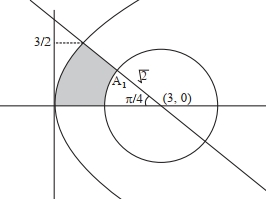
If the area bounded by the curve $2 y^2=3 x$, lines $x+y=3, y=0$ and outside the circle $(x-3)^2+y^2=2$ is $A$, then $4(\pi+4 A )$ is equal to $.........$.
For any real number $x$, let $[ x ]$ denote the largest integer less than equal to $x$. Let $f$ be a real valued function defined on the interval $[-10,10]$ by $f(x)=\left\{\begin{array}{cl}x-[x], & \text { if }(x) \text { is odd } \\ 1+[x]-x & \text { if }(x) \text { is even }\end{array}\right.$ Then the value of $\frac{\pi^{2}}{10} \int_{-10}^{10} f(x) \cos \pi x d x$ is.
Region represented by $x \geq 0, y \geq 0$ is
The equation of the curve passing through the origin and satisfying the equation $(1 + {x^2})\frac{{dy}}{{dx}} + 2xy = 4{x^2}$ is
Let $f (\theta)=\sin \theta+\int_{-\pi / 2}^{\pi / 2}(\sin \theta+ t \cos \theta) f ( t ) dt$. Then the value of $\left|\int_{0}^{\pi / 2} f (\theta) d \theta\right|$ is
Let $I_1 = \int\limits_0^{\frac{\pi }{2}} {{e^{ - {x^2}}}\sin (x)dx} $ ; $I_2 = \int\limits_0^{\frac{\pi }{2}} {{e^{ - {x^2}}}dx} $ ; $I_3 = \int\limits_0^{\frac{\pi }{2}} {{e^{ - {x^2}}}(1 + x)\,dx} $

and consider the statements

$I\,:$ $I_1 < I_2$   

$II\,:$  $I_2 < I_3$ 

$III\,:$  $I_1 = I_3$

Which of the following is $(are)$ true?

If two rows of a determinant are identical, then what is the value of the determinant ?
  1. 0
  2. 1
  3. -1
  4. Can be any real value.