MCQ
$\int_0^{\pi /2} {\frac{{d\theta }}{{1 + \tan \theta }}} = $
  • A
    $\pi $
  • B
    $\frac{\pi }{2}$
  • C
    $\frac{\pi }{3}$
  • $\frac{\pi }{4}$

Answer

Correct option: D.
$\frac{\pi }{4}$
d
(d) $I = \int_0^{\pi /2} {\frac{{d\theta }}{{1 + \tan \theta }} = \int_0^{\pi /2} {\frac{{d\theta }}{{1 + \tan \left( {\frac{\pi }{2} - \theta } \right)}}} } $

$ = \int_0^{\pi /2} {\frac{{d\theta }}{{1 + \cot \theta }}} $

On adding, $2I = \int_0^{\pi /2} {\left( {\frac{1}{{1 + \tan \theta }} + \frac{1}{{1 + \cot \theta }}} \right)\,d\theta } $

$= \int_0^{\pi /2} {d\theta = [\theta ]_0^{\pi /2} = \frac{\pi }{2} \Rightarrow I = \frac{\pi }{4}} $.

Need a full question paper?

Generate a complete, print-ready paper with questions like this in minutes — across 16+ boards, with answer keys.

Start Generating Free

Similar questions

All the points in the set $S\, = \left\{ {\frac{{\alpha \, + \,i}}{{\alpha \, - \,i}}\,:\,\alpha \, \in \,R} \right\}\,(i\, = \,\sqrt { - 1} )$ lie on a
$\left| {\,\begin{array}{*{20}{c}}{1 + x}&1&1\\1&{1 + y}&1\\1&1&{1 + z}\end{array}\,} \right| = $
Let the relations $R_1$ and $R_2$ on the set
$X =\{1,2,3, \ldots, 20\}$ be given by
$R _1=\{( x , y ): 2 x -3 y =2\}$ and
$R_2=\{(x, y):-5 x+4 y=0\}$. If $M$ and $N$ be the minimum number of elements required to be added in $R_1$ and $R_2$, respectively, in order to make the relations symmetric, then $M + N$ equals
If ${(1 + x)^n} = {C_0} + {C_1}x + {C_2}{x^2} + .... + {C_n}{x^n}$, then the value of ${C_0} + 2{C_1} + 3{C_2} + .... + (n + 1){C_n}$ will be
A rectangular hyperbola of latus rectum $2$ units passes through $(0, 0)$ and has $(1, 0)$ as its one focus. The other focus lies on the curve -
If the length of the tangents drawn from the point $(1,2)$ to the circles ${x^2} + {y^2} + x + y - 4 = 0$ and $3{x^2} + 3{y^2} - x - y + k = 0$ be in the ratio $4 : 3$, then $k =$
Let $a=i-k,\,\,\,b=xi+j+(1-x)\,k$  ,$c = yi + xj + (1 + x - y)k$. Then $[a\,b\,c]$ depends on
If $f\, \&\, g$ are continuous functions in $[0, a]$ satisfying $f (x) = f (a - x)\, \&\, g (x) + g (a - x) = 4$ then $\int\limits_0^a {\,f\,(x)\,\,.\,\,g\,(x)dx} $ $=$
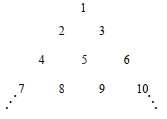
Let the positive integers be written in the form :

$Image$

If the $\mathrm{k}^{\text {th }}$ row contains exactly $\mathrm{k}$ numbers for every natural number $\mathrm{k}$, then the row in which the number $5310$ will be, is.........
On the ellipse $\frac{{{x^2}}}{{18}} + \frac{{{y^2}}}{8} = 1$ the point $M$ nearest to the line $2x - 3y + 25 = 0$ is