MCQ
$\int_1^2 \frac{1}{x^2} e ^{\frac{-1}{x}} d x=$
  • A
    $\sqrt{ e }+1$
  • B
    $\sqrt{ e }-1$
  • C
    $\frac{\sqrt{ e }+1}{ e }$
  • $\frac{\sqrt{ e }-1}{ e }$

Answer

Correct option: D.
$\frac{\sqrt{ e }-1}{ e }$
(D)
Put $t =-\frac{1}{x} \Rightarrow dt =\frac{1}{x^2} d x$
When $x=1, t =-1$ and when $x=2, t =\frac{-1}{2}$
$\therefore \int_1^2 \frac{1}{x^2} e ^{-\frac{1}{x}} d x=\int_{-1}^{-1 / 2} e ^{ t } dt =\left[ e ^{ t }\right]_{-1}^{-1 / 2}$
$= e ^{\frac{-1}{2}}- e ^{-1}=\frac{\sqrt{ e }-1}{ e }$

Need a full question paper?

Generate a complete, print-ready paper with questions like this in minutes — across 16+ boards, with answer keys.
Start Generating Free

Similar questions

If the equation $a x^2+b y^2+c x+c y=0$ represents a pair of straight lines, then
If the vectors $4\hat{\text{i}}+11\hat{\text{j}}+\text{m}\hat{\text{k}},7\hat{\text{i}}+2\hat{\text{j}}+6\hat{\text{k}}$ and $\hat{\text{i}}+5\hat{\text{j}}+4\hat{\text{k}}$ are coplanar, then $m =$
The element of second row and third column in the inverse of $\left[\begin{array}{ccc}1 & 2 & 1 \\ 2 & 1 & 0 \\ -1 & 0 & 1\end{array}\right]$ is
The value of $\tan\Big(\cos^{-1}\frac{3}{5}+\tan^{-1}\frac{1}{4}\Big)=$
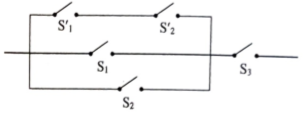
The simplified circuit for the following circuit is

Image
If $\bar{a}, \bar{b}$ and $\bar{c}$ are non-coplanar vectors and the four points with position vectors $2 \bar{a}+3 \bar{b}-\bar{c}$, $\overline{ a }-2 \overline{b}+3 \overline{ c }, \quad 3 \overline{ a }+4 \overline{b}-2 \overline{ c }$ and $k \overline{ a }-6 \overline{b}+6 \overline{ c }$ are coplanar, then $k =$
If $\big[2\vec{\text{a}}+4\vec{\text{b}}\vec{\text{c}}\vec{\text{d}}\big]=\lambda\big[\vec{\text{a}}\vec{\text{c}}\vec{\text{d}}\big]+\mu\big[\vec{\text{b}}\vec{\text{c}}\vec{\text{d}}\big],$ then $\lambda+\mu=$
Let $\alpha, \beta, \gamma$ be distinct real numbers. The points with position vectors $\alpha \hat{i}+\beta \hat{j}+\gamma \dot{k}$, $\beta \hat{i}+\gamma \hat{j}+\alpha \hat{k}, \gamma \hat{i}+\alpha \hat{j}+\beta \hat{k}$
If one of the lines represented by the equation $a x^2+2 h x y+ b y^2=0$ be $y= m x$, then
The logical statement $(p \rightarrow q) \wedge(q \rightarrow \sim p)$ is equivalent to: