Question
Integrate the following integrals:
$\int\sin2\text{x}\sin4\text{x}\sin6\text{x dx}$

Answer

$\int\sin2\text{x}\sin4\text{x}\sin6\text{x dx}$
$=\frac{1}{2}\int(2\sin2\text{x}\sin4\text{x})\sin6\text{x dx}$
$=\frac{1}{2}\int\big[\cos(2\text{x}-4\text{x})-\cos(2\text{x}+4\text{x})\big]\sin6\text{x dx}$
$=\frac{1}{2}\int\big[\cos(2\text{x})-\cos(6\text{x})\big]\sin6\text{x dx}$
$=\frac{1}{2}\big[\int\cos(2\text{x})\sin(6\text{x})\text{dx}-\int\cos(6\text{x})\sin(6\text{x})\text{dx}\big]$
$=\frac{1}{4}\big[\int2\cos(2\text{x})\sin(6\text{x})\text{dx}-\int2\cos(6\text{x})\sin(6\text{x})\text{dx}\big]$
$=\frac{1}{4}\Big\{\int\big[\sin(2\text{x}+6\text{x})-\sin(2\text{x}-6\text{x})\big]\text{dx}-\int\sin(12\text{x})\text{dx}\Big\}$
$=\frac{1}{4}\Big[\int\sin(8\text{x})\text{dx}+\int\sin(4\text{x})\text{dx}-\int\sin(12\text{x})\text{dx}\Big]$
$=\frac{1}{4}\Big[\frac{-\cos(8\text{x})}{8}+\frac{-\cos(4\text{x})}{4}+\frac{\cos(12\text{x})}{12}\Big]+\text{C}$
$=-\frac{\cos(8\text{x})}{32}-\frac{\cos(4\text{x})}{16}+\frac{\cos(12\text{x})}{48}+\text{C}$

Need a full question paper?

Generate a complete, print-ready paper with questions like this in minutes — across 16+ boards, with answer keys.
Start Generating Free

Similar questions

Let X denot the number of colleges where you will apply after your results and P(X = x) denotes your probability of getting admission in x number of colleges. It is given that
$\text{P}(\text{X = x})=\begin{cases}\text{kx},&\text{if}\text{ x}=0\text{ or }1\\2\text{kx},&\text{if x = 2}\\\text{k}(5-\text{x}),&\text{if x = 3 or 4}\\0,&\text{if x > 4}\end{cases}$
where k is a positive constant. Find the value of k. Also find the probability that you will get addmission in
  1. Exactly one college.
  2. At most two colleges.
  3. At least two colleges.
Show that the points A, B, C with position vectors $2\hat{\text{i}} - \hat{\text{j}} + \hat{\text{k}}, \hat{\text{i}} - 3\hat{\text{j}} - 5\hat{\text{k}} \text{ and } 3\hat{\text{i}} - 4\hat{\text{j}} - 4\hat{\text{k}}$ respectively, are the vertices of a right-angled triangle. Hence find the area of the triangle.
Solve the following differential equation:
$\text{2x}^{2}\frac{\text{dy}}{\text{dx}}-\text{2 xy + y}^{2}=0$
Find a unit vector perpendicular to each of the vectors $\vec{\text{a}}+\vec{\text{b}}$ and $\vec{\text{a}}-\vec{\text{b}},$ where $\vec{\text{a}}=3\hat{\text{i}}+2\hat{\text{j}}+2\hat{\text{k}}$ and $\vec{\text{b}}=\hat{\text{i}}+2\hat{\text{j}}-2\hat{\text{k}}.$
Find the intervals in which the following functions are increasing or decreasing.
$f(x) = 2x^3 - 24x + 107$
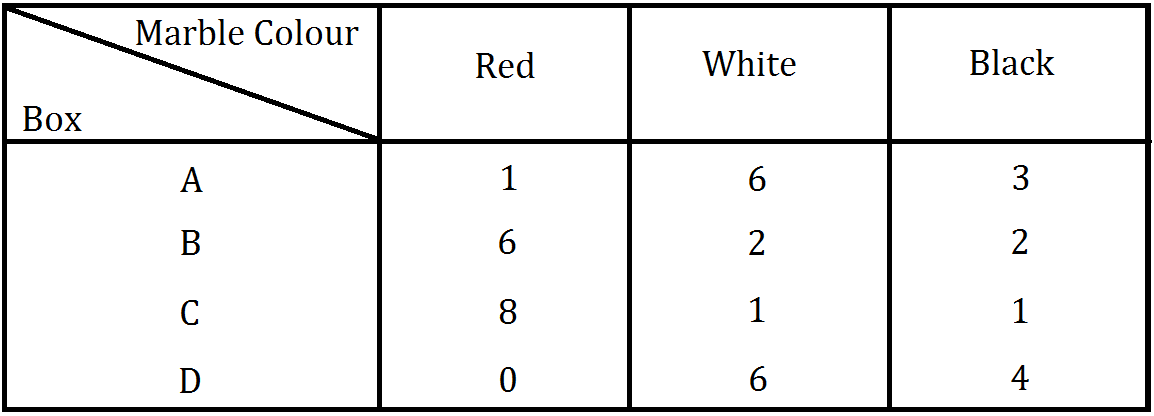
Suppose we have four boxes A, B, C, D containing coloured marbles as given below:
One of the boxes has been selected at random and a single marble is drawn from it. If the marble is red, what is the probability that it was drawn from,
  1. Box A?
  2. Box B?
  3. Box C?
If $\sin(\text{xy})+\frac{\text{y}}{\text{x}}=\text{x}^2-\text{y}^2,$ find $\frac{\text{dy}}{\text{dx}}$
Evaluate the following determinant:
$\begin{vmatrix}1&3&9&27\\3&9&27&1\\9&27&1&3\\27&1&3&9 \end{vmatrix}$
Find $\frac{\text{dy}}{\text{dx}}$
$\text{y}=\sin\text{x}\sin2\text{x}\sin3\text{x}\sin4\text{x}$
$\text{Let A} = \begin{bmatrix}3&7\\2&5\end{bmatrix}\text{and B} = \begin{bmatrix}6&8\\7&9\end{bmatrix}.$Verify that $(AB)^{-1} = B^{-1}A^{-1}$.