Question
Integrate the function: $\frac{\sqrt{\tan x}}{\sin x \cos x}$

Answer

Let $I=\int \frac{\sqrt{\tan x}}{\sin x \cos x}$ 
$=\int \frac{\sqrt{\tan x} \cdot \cos x}{\sin x \cos x \cdot \cos x} d x$ 
$= \int \frac{\sqrt{\tan x}}{\tan x \cos ^{2} x} d x$ 
$= \int \frac{\sec ^{2} x d x}{\sqrt{\tan x}}$ 
Let tan x = t $\Rightarrow$ sec2x dx = dt
$\Rightarrow I=\int \frac{d t}{\sqrt{t}}$ 
$=2 \sqrt{t}+C$ 
$=2 \sqrt{\tan x}+c$

Need a full question paper?

Generate a complete, print-ready paper with questions like this in minutes — across 16+ boards, with answer keys.

Start Generating Free

Similar questions

If $\text{A} = \begin{pmatrix} 2 & -3 & 5 \\ 3 & 2 & -4 \\ 1 &1 & -2 \end{pmatrix}$ find A–1. Hence using A–1 solve the system of equations 2x – 3y + 5z = 11, 3x + 2y – 4z = – 5, x + y – 2z = – 3.
Find the angle between the following pairs of lines:

$\frac{5-\text{x}}{-2}=\frac{\text{y}+3}{1}=\frac{1-\text{z}}{3}$ and $\frac{\text{x}}{3}=\frac{1-\text{y}}{-2}=\frac{\text{z}+5}{-1}$
If $\text{f}\text{(x)}=\begin{cases}\frac{1-\cos\text{x}}{\text {x}^2}, & \text{when} \text{ x}\neq 0\\1, & \text{when}\text{ x} = 0\end{cases}$ Show that f(x) is discontinuous at x = 0.
Using properties of determinants, prove that
$\begin{vmatrix} \text{a}^{2} + \text{2a} & \text{2a + 1} & 1 \\ \text{2a + 1} & \text{a + 2} & 1 \\ 3 & 3 & 1 \end{vmatrix} = \text{(a - 1)}^{3}$
Find the intervals in which the following functions are increasing or decreasing.
f(x) = {x(x - 2)}2
Solve the following differential equations:
$\frac{\text{dy}}{\text{dx}}=\frac{\text{x + y}}{\text{x}-\text{y}}$
Evaluate the following integrals:
$\int_{0}^\limits{\frac{\pi}{2}}\sqrt{\sin\phi}\cos^5\phi\text{ d}\phi$
Solve the following differential equation:
$(1+\text{x}^2)\frac{\text{dy}}{\text{dx}}+\text{y}=\text{e}^{\tan^{-1}\text{x}}$
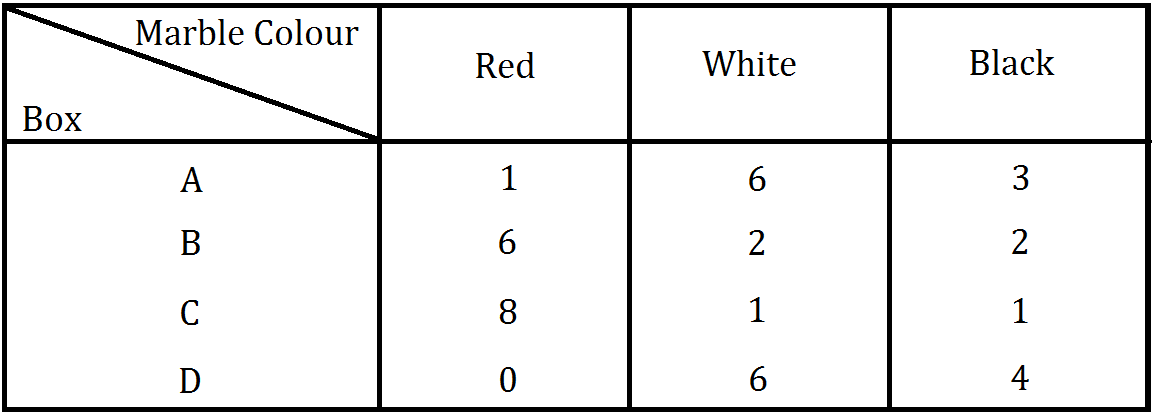
Suppose we have four boxes A, B, C, D containing coloured marbles as given below:

One of the boxes has been selected at random and a single marble is drawn from it. If the marble is red, what is the probability that it was drawn from,

  1. Box A?
  2. Box B?
  3. Box C?
Consider a non-empty set consisting of children in a family and a relation R defined as aRb if a is brother of b. Then, R is:
  1. Symmetric but not transitive.
  2. Transitive but not symmetric.
  3. Neither symmetric nor transitive.
  4. Both symmetric and transitive.