Question
Integrate the function $\sqrt{x^{2}+4 x-5}$

Answer

$I=\sqrt{x^{2}+4 x-5} d x$
= $\int \sqrt{\left(x^{2}+4 x+4\right)-9} d x$
= $\int \sqrt{(x+2)^{2}-(3)^{2}} d x$
We know that,
$\Rightarrow \int \sqrt{x^{2}-a^{2}} d x=\frac{x}{2} \sqrt{x^{2}-a^{2}}-\frac{a^{2}}{2} \log |x+\sqrt{x^{2}-a^{2}}|+C$
$\Rightarrow \mathrm{I}=\frac{(\mathrm{x}+2)}{2} \sqrt{\mathrm{x}^{2}+4 \mathrm{x}-5}-\frac{9}{2} \log |(\mathrm{x}+2)+\sqrt{\mathrm{x}^{2}+4 \mathrm{x}-5}|+\mathrm{C}$

Need a full question paper?

Generate a complete, print-ready paper with questions like this in minutes — across 16+ boards, with answer keys.
Start Generating Free

Similar questions

Evaluate the following definite integrals:
$\int_{1}^\limits{2}\text{e}^{2\text{x}}\Big(\frac{1}{\text{x}}-\frac{1}{2\text{x}^2}\big)\text{dx}$
Without using the derivative show that the function f(x) = 7x - 3 is strictly increasing function on R.
Using differentials, find the approximate value of each of the following up to 3 places of decimal.
$(26. 57)^{\frac{1}{3}}$
Prove the following:
$\tan^{-1}\sqrt{x}=\frac{1}{2}\cos^{-1}\Bigg(\frac{1-x}{1+x}\Bigg),\text{x }\in(0, 1)$.
Differentiate the following functions with respect to x:
$\sin^{-1}\Big(\frac{1-\text{x}^2}{1+\text{x}^2}\Big)+\sec^{-1}\Big(\frac{1+\text{x}^2}{1-\text{x}^2}\Big),\text{x}\in\text{R}$
If the percentage error in the radius of a sphere is $\alpha,$ find the percentage error in its volume.
Differentiate the following w.r.t. x:
$(\sin\text{x})^{\cos\text{x}}$
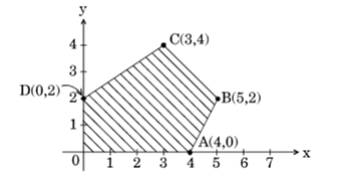
The corner points of the feasible region determined by the system of linear inequations are as shown below:
Image

Answer each of the following:
$i.$ Let $z = 13x - 15y$ be the objective function. Find the maximum and minimum values of $z$ and also the
corresponding points at which the maximum and minimum values occur.
$ii.$ Let $z = kx + y$ be the objective function. Find $k,$ if the value of $z$ at $A$ is same as the value of $z$ at $B.$
For two matrices A and B, $\text{A}=\begin{bmatrix}2&1&3\\4&1&0\end{bmatrix},\text{B}=\begin{bmatrix}1&-1\\0&2\\5&0\end{bmatrix}$ verify that $(AB)^T = B^TA^T$.
Differentiate the following w.r.t. x:
$2^{\cos^2}\text{x}$