Question

Interference is based on the superposition principle. According to this principle, at a particular point in the medium, the resultant displacement produced by a number of waves is the vector sum of the displacements produced by each of the waves.
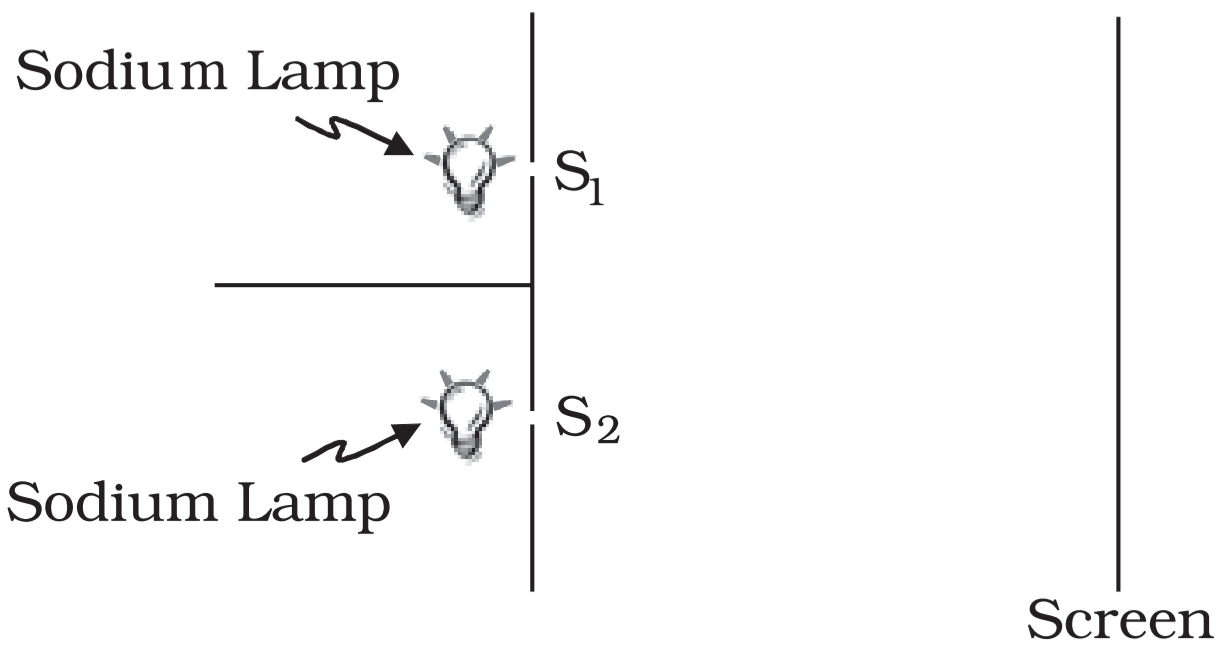
If two sodium lamps illuminate two pinholes $S_1$ and $S_2$, the intensities will add up and no interference fringes will be observed on the screen.
Here the source undergoes abrupt phase change in times of the order of $10^{-10}$ seconds.
  1. Two coherent sources of intensity $\text{10 }\frac{\text{W}}{\text{m}^2}$ and $\text{25 }\frac{\text{W}}{\text{m}^2}$ interfere to form fringes. Find the ratio of maximum intensity to minimum intensity.
  1. $15.54$
  2. $16.78$
  3. $19.72$
  4. $18.39$
  1. Which of the following does not show interference?
  1. Soap bubble.
  2. Excessively thin film.
  3. A thick film.
  4. Wedge shaped film.
  1. ln a Young's double-slit experiment, the slit separation is doubled. To maintain the same fringe spacing on the screen, the screen-to-slit distance D must be changed to:
  1. 2D
  2. 4D
  3. $\frac{\text{D}}{2}$
  4. $\frac{\text{D}}{4}$
  1. The maximum number of possible interference maxima for slit separation equal to twice the wavelength in Young's double-slit experiment, is:
  1. Infinite
  2. Five
  3. Three
  4. Zero
  1. The resultant amplitude of a vibrating particle by the superposition of the two waves.
$\text{y}_1=\text{a}\sin\Big[\omega\text{t}+\frac{\pi}{3}\Big]$ and $\text{y}_2=\text{a}\sin\omega\text{t}$ is:
  1. $\text{a}$
  2. $\sqrt2\text{a}$
  3. $\text{2a}$
  4. $\sqrt3\text{a}$

Answer

  1. (c) 19.72
Explanation:
Given $\text{I}_1=\text{10 }\frac{\text{W}}{\text{m}^2}$ and $\text{I}_2=\text{25 }\frac{\text{W}}{\text{m}^2}$
$\frac{\text{I}_1}{\text{I}_2}=\frac{\text{a}^2_1}{\text{a}^2_2}=\frac{10}{25}\Rightarrow\frac{\text{a}_1}{\text{a}_2}=\frac{3.16}{5}$ or
$\text{a}_1=\frac{3.16}{5}\text{a}_2=0.6324\text{a}_2$
$\frac{\text{I}_\text{max}}{\text{I}_\text{min}}=\frac{(\text{a}_1+\text{a}_2)^2}{(\text{a}_1-\text{a}_2)^2}=\frac{[0.6324\text{a}_2+\text{a}_2]^2}{[0.6324\text{a}_2-\text{a}_2]^2}=19.724$
  1. (b) Excessively thin film.
Explanation:
In an excessively thin film, the thickness of the film is negligible. Thus the path difference between the reflected rays becomes $\frac{\lambda}{2}$ which produces a minima.
  1. (a) 2D
Explanation:
Since, $\beta=\frac{\lambda\text{D}}{\text{d}}$ for d = 2d,
$\beta'=\frac{\lambda\text{D}'}{2\text{d}}=\beta$ (Gives)
$\therefore D_1 = 2D$
  1. (b) Five
Explanation:
The condition for possible interference maxima on the screen is, $\text{d}\sin\theta=\text{n}\lambda$
where d is slit separation and $\lambda$ is the wavelength.
As $\text{d}=2\lambda$ (given) $\therefore2\lambda\sin\theta=\text{n}\lambda$ or $2\sin\theta=\text{n}$
For number of interference maxima to be maximum,
$\sin\theta=1\ \ \ \therefore\ \ \ \text{n}=2$
The interference maxima will be formed when
$\text{n}=0,\pm1,\pm2$
Hence the maximum number of possible maxima is 5.
  1. (d) $\sqrt3\text{a}$
Explanation:
$\text{y}_1=\text{a}\sin\Big(\omega\text{t}\frac{\pi}{3}\Big)$ and $\text{y}_2=\text{a}\sin\omega\text{t}$
$\text{A}=\sqrt{\text{a}_1^2+\text{a}^2_2+2\text{a}_1\text{a}_2\cos\phi}$, where $\phi=\frac{\pi}{3}$
$=\sqrt{\text{a}^2+\text{a}^2+2\text{aa}\cos\frac{\pi}{3}}=\sqrt3\text{a}$

Need a full question paper?

Generate a complete, print-ready paper with questions like this in minutes — across 16+ boards, with answer keys.

Start Generating Free

Similar questions

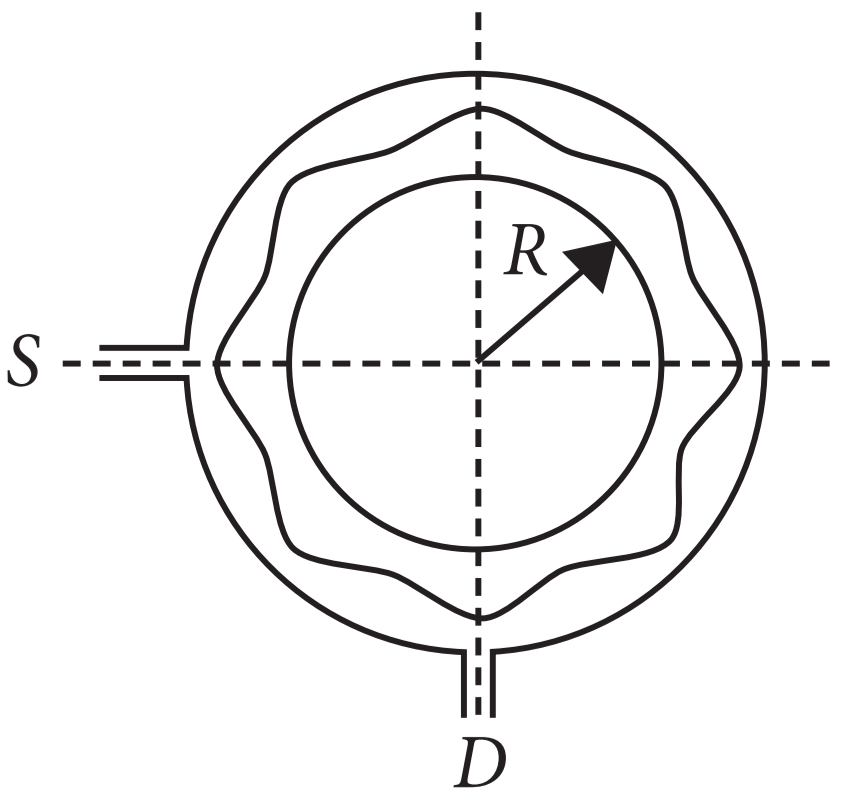
A narrow tube is bent in the form of a circle of radius R, as shown in figure. Two small holes S and D are made in the tube at the positions at right angle to each other. A source placed at S generates a wave of intensity $I_0$ which is equally divided into two parts: one part travels along the longer path, while the other travels along the shorter path. Both the waves meet at point Dwhere a detector is place
  1. If a maxima is formed at a detector, then the magnitude of wavelength $\lambda$ of the wave produced is given by:
  1. $\pi\text{R}$
  2. $\frac{\pi\text{R}}{2}$
  3. $\frac{\pi\text{R}}{4}$
  4. All of these.
  1. If the in tensity ratio of two coherent sources used in Young's double slit experiment is 49 : 1, then the ratio between the maximum and minimum intensities in the interference pattern is:
  1. $1 : 9$
  2. $9 : 16$
  3. $25 : 16$
  4. $16 : 9$
  1. The maximum intensity produced at D is given by:
  1. $4I_0$
  2. $2I_0$
  3. $I_0$
  4. $3I_0$
  1. ln a Young's double slit experiment, the intensity at a point where the path difference is $\frac{\lambda}{6}$ ($\lambda$ - wavelength of the light) is I. If $I_0$ denotes the maximum intensity, then $I/I_0$ is equal to:
  1. $\frac{1}{2}$
  2. $\frac{\sqrt3}{2}$
  3. $\frac{1}{\sqrt2}$
  4. $\frac{3}{4}$
  1. Two identical light waves, propagating in the same direction, have a phase differenced. After they superpose the intensity of the resulting wave will be proportional to:
  1. $\cos\delta$
  2. $\cos\Big(\frac{\delta}{2}\Big)$
  3. $\cos^2\Big(\frac{\delta}{2}\Big)$
  4. $\cos^2\delta$
When light of sufficiently high frequency is incident on a metallic surface, electrons are emitted from the metallic surface. TI1is phenomenon is called photoelectric emission. Kinetic energy of the emitted photoelectrons depends on the wavelength of incident tight and is independent of the intensity of light. Number of emitted photoelectrons depends on intensity. $(\text{h}\upsilon-\phi)$ is the maximum kinetic energy of emitted photoelectrons (where $\phi$ is the work function of metallic surface). Reverse effect of photo emission produces X-ray. X-ray is not deflected by electric and magnetic fields. Wavelength of a continuous X-ray depends on potential difference across the tube. Wavelength of characteristic X-ray depends on the atomic number.
  1. Einstein's photoelectric equation is:
  1. $\text{E}_\text{max}=\text{h}\upsilon-\phi$
  2. $\text{E}=\text{mc}^2$
  3. $\text{E}^2=\text{p}^2\text{c}^2+\text{m}_0^2\text{c}^4$
  4. $\text{E}=\frac{1}{2}\text{mv}^2$
  1. Light of wavelength $\lambda$ which is less than threshold wavelength is incident on a photosensitive material. If incident wavelength is decreased so that emitted photoelectrons are moving with some velocity then stopping potential will:
  1. Increase.
  2. Decrease.
  3. Be zero.
  4. Become exactly half.
  1. When ultraviolet rays incident on metal plate then photoelectric effect does not occur, it occur by incident of:
  1. Infrared rays
  2. X-rays
  3. Radio wave
  4. Micro wave
  1. If frequency $(\upsilon>\upsilon_0)$ of incident light becomes n times the initial frequency $(\upsilon)$, then K.E. of the emitted photoelectrons becomes ($\upsilon_0$ threshold frequency).
  1. N times of the initial kinetic energy.
  2. More than n times of the initial kinetic energy.
  3. Less than n times of the initial kinetic energy.
  4. Kinetic energy of the emitted photoelectrons remains unchanged.
  1. A monochromatic light is used in a photoelectric experiment. The stopping potential.
  1. Is related to the mean wavelength.
  2. Is related to the shortest wavelength.
  3. Is not related to the minimum kinetic energy of emitted photoelectrons.
  4. Intensity of incident tight.
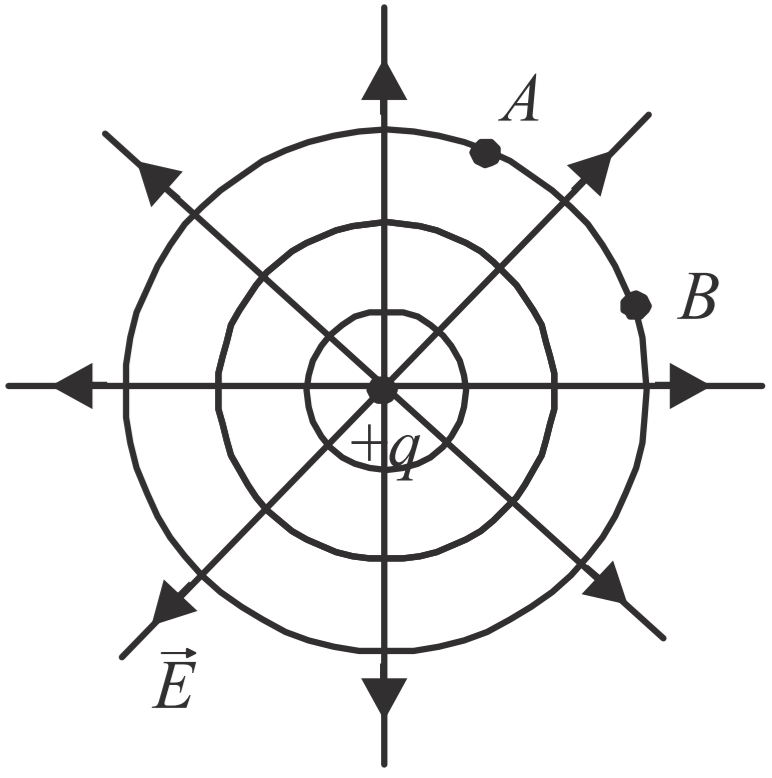
For the various charge systems, we represent equipotential surfaces by curves and line of force by full line curves. Between any two adjacent equipotential surfaces, we assume a constant potential difference the equipotential surfaces of a single point charge are concentric spherical shells with their centres at the point charge. As the tines of force point radially outwards, so they are perpendicular to the equipotential surfaces at all points.
  1. Identify the wrong statement.
  1. Equipotential surface due to a single point charge is spherical.
  2. Equipotential surface can be constructed for dipoles too.
  3. The electric field is normal to the equipotential surface through the point.
  4. The work done to move a test charge on the equipotential surface is positive.
  1. Nature of equipotential surface for a point charge is:
  1. Ellipsoid with charge at foci.
  2. Sphere with charge at the centre of the sphere.
  3. Sphere with charge on the surface of the sphere.
  4. Plane with charge on the surface.
  1. A spherical equipotential surface is not possible:
  1. Inside a uniformly charged sphere.
  2. For a dipole.
  3. Inside a spherical condenser.
  4. For a point charge.
  1. The work done in carrying a charge q once round a circle of radius a with a charge Q at its centre is:
  1. $\frac{\text{qQ}}{4\pi\in_0\text{a}}$
  2. $\frac{\text{qQ}}{4\pi\in_0\text{a}^2}$
  3. $\frac{\text{q}}{4\pi\in_0\text{a}}$
  4. $\text{Zero}$
  1. The work done to move a unit charge along an equipotential surface from P to Q:
  1. Must be defined as $-\int\limits_{\text{P}}^{\text{Q}}\vec{\text{E}}\cdot\text{d}\vec{\text{l}}.$
  2. Is zero.
  3. Can have a non-zero value.
  4. Both (a) and (b) are correct.
Motion of Charge in Magnetic Field
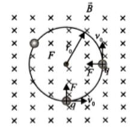
An electron with speed $V_0$ << c moves in a circle of radius $r _{\circ}$ in a uniform magnetic field. This electron is able to traverse a circular path as the magnetic force acting on the electron is perpendicular to both $V_0$ and B ,as shown in the figure. This force continuously deflects the particle sideways without changing its speed and the particle will move along a circle perpendicular to the field. The time required for one revolution of the electron is $T _{ o }$.

Image

(i) If the speed of the electron is now doubled to 2vo. The radius of the circle will change to
(A) $4 r_0$ (B) $2 r_0$ (C) $r _{ o }$ (D) $r _0 / 2$

(ii) If v = 2vo, then the time required for one revolution of the electron (To ) will change to
(A) $4 T_0$ (B) $2 T_{ O }$ (C) $T _{ o }$ (D) $T _{ d } / 2$
(iii) A charged particles is projected in a magnetic field . The acceleration of the particle is found to be. Find the value of x.
(A) $4 ms^{-2}$ (B) $-4 ms^{-2}$ (C) $-2 ms^{-2}$ (D) $2 ms^{-2}$

(iv) If the given electron has a velocity not perpendicular to B, then trajectory of the electron is
(A) straight line (B) circular (C) helical (D) zig-zag

OR

If this electron of charge (e) is moving parallel to uniform magnetic field with constant velocity v, the force acting on the electron is
(A) Bev (B) Be/v (C) B/ev (D) Zero
An electromagnetic wave transports linear momentum as it travels through space. If an electromagnetic wave transfers a total energy $U$ to a surface in time $t ,$ then total linear momentum delivered to the surface is $p =\frac{U}{c}$. When an electromagnetic wave falls on a surface, it exerts pressure on the surface. In $1903,$ the American scientists Nichols and Hull succeeded in measuring radiation pressures of visible light where other had failed, by making a detailed empirical analysis of the ubiquitous gas heating and ballistic effects.
$(i)$ The pressure exerted by an electromagnetic wave of intensity $I \left( W m ^{-2}\right)$ on a non $-$ reflecting surface is $( c$ is the velocity of light$)$
$(a)\ \frac{I}{c}$
$(b) \ \frac{I}{c^2}$
$(c) \ Ic ^2$
$(d) \ IC$
$(ii)$ Light with an energy flux of $18 W / cm ^2$ falls on a non $-$ reflecting surface at normal incidence.
The pressure exerted on the surface is:
$(a)\ 2 N / m ^2$
$(b)\ 6 \times 10^{-4} N / m ^2$
$(c)\ 2 \times 10^{-4} N / m ^2$
$(d)\ 6 N / m ^2$
$(iii)$ Radiation of intensity $0.5 W m ^{-2}$ are striking a metal plate. The pressure on the plate is
$(a)\ 0.212 \times 10^{-8} N m ^{-2}$
$(b)\ 0.132 \times 10^{-8} N m ^{-2}$
$(c)\ 0.166 \times 10^{-8} N m ^{-2}$
$(d)\ 0.083 \times 10^{-8} N m ^{-2}$
OR
The radiation pressure of the visible light is of the order of
$(a)\ 10^{-4} N / m$
$(b)\ 10^{-6} N / m ^2$
$(c)\ 10^{-8} N$
$(d)\ 10^{-2} N m ^2$
$(iv)$ A point source of electromagnetic radiation has an average power output of $1500 W$ . The maximum value of electric field at a distance of $3 m$ from this source $($in $V m ^{-1})$ is
$(a)\ 500$
$(b)\ \frac{500}{3}$
$(c)\ \frac{250}{3}$
$(d)\ 100$
Currents can be induced not only in conducting coils, but also in conducting sheets or blocks. Current is induced in solid metallic masses when the magnetic flux threading through them changes. Such currents flow in the from of irregularly shaped loops throughout the body of the metal. These currents look like eddies or whirlpools in water so they are known as eddy currents. Eddy currents have both undesirable effects and practically useful applications. For example it causes unnecessary heating and wastage of power in electric motors, dynamos and in the cores of transformers.
  1. The working of speedometers of trains is based on:
  1. Wattless currents.
  2. Eddy currents.
  3. alternating currents.
  4. pulsating currents.
  1. Identify the wrong statement.
  1. Eddy currents are produced in a steady magnetic field.
  2. Induction furnace uses eddy currents to produce heat.
  3. Eddy currents can be used to produce braking force in moving trains.
  4. Power meters work on the principle of eddy currents.
  1. Which of the following is the best method to reduce eddy currents?
  1. Laminating core.
  2. Using thick wires.
  3. By reducing hysteresis loss.
  4. None of these.
  1. The direction of eddy currents is given by:
  1. Fleming's left hand rule.
  2. Biot-Savart law.
  3. Lenz's law
  4. Ampere-circuital law.
  1. Eddy currents can be used to heat localised tissues of the human body. This branch of medical therapy is called:
  1. Hyperthermia.
  2. Diathermy.
  3. Inductothermy.
  4. None of these.
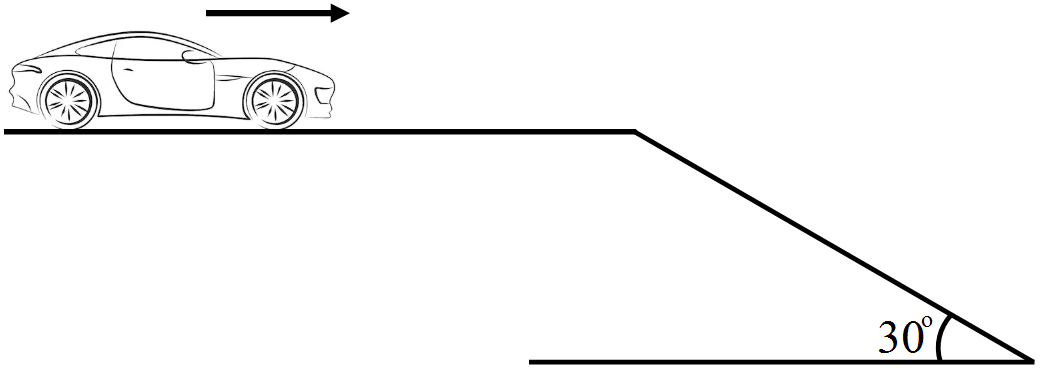
A car is going at a speed of 21.6km/hr when it encounters a 12.8m long slope of angle 30°. The friction coefficient between the road and the tyre is $\frac{1}{2\sqrt{3}}.$ Show that no matter how hard the driver applies the brakes, the car will reach the bottom with a speed greater than 36km/hr. Take $g = 10m/s^2.$
A metal rod is placed along the axis of a solenoid carrying a high-freqμency alternating current. It is found that the rod gets heated. Explain why the rod gets heated.
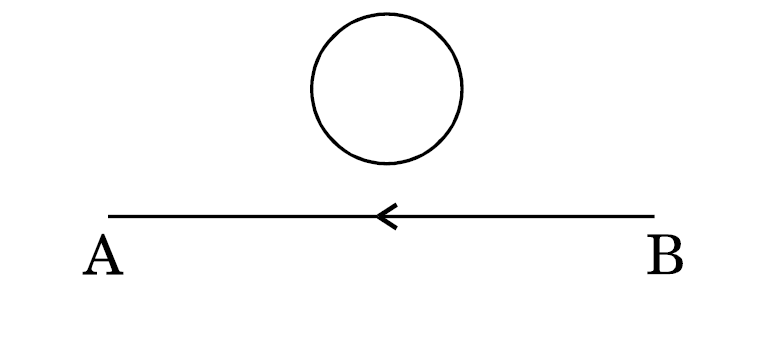
The electric current flowing in a wire in the direction from B to A is decreasing. Find out the direction of the induced current in the metallic loop kept above the wire as shown.
A player hits a baseball at some angle. The ball goes high up in space. The player runs and catches the ball before it hits the ground. Which of the two (the player or the ball) has greater displacement?