MCQ
$\int\limits^\infty_0\frac{1}{1+\text{e}^\text{x}}\text{dx}$ equals:
  • $\log2-1$
  • B
    $\log2$
  • C
    $\log4-1$
  • D
    $-\log2$

Answer

Correct option: A.
$\log2-1$
$\int\limits^\frac{\pi^2}{4}_0\frac{\sin\sqrt{\text{x}}}{\sqrt{\text{x}}}\text{dx}$
Let $\sqrt{\text{x}}=\text{t},$ then $\frac{1}{2\sqrt{\text{x}}}\text{dx}=\text{dt}$
when $\text{x}=0,\text{t}=0,\text{x}=\frac{\pi^2}{4},\text{t}=\frac{\pi}{2}$
Therefore the integral becomes
$\int\limits^\frac{\pi}{2}_02\sin\text{t}\text{ dt}$
$=-2\big[\cos\text{t}\big]^\frac{\pi}{2}_0$
$=2$

Need a full question paper?

Generate a complete, print-ready paper with questions like this in minutes — across 16+ boards, with answer keys.
Start Generating Free

Similar questions

If $\text{f}(\text{x})=\Big(\frac{\text{x}^\text{l}}{\text{x}^\text{m}}\Big)^{\text{l}+\text{m}}\Big(\frac{\text{x}^\text{m}}{\text{x}^\text{n}}\Big)^{\text{m}+\text{n}}\Big(\frac{\text{x}^\text{n}}{\text{x}^\text{l}}\Big)^{\text{n}+1},$ the $f\ '(x)$ is equal to:
If $y=\left(1+\frac{1}{x}\right)^x$, then $\frac{d y}{d x}=$
Let $\overrightarrow{ a }$ be a non-zero vector parallel to the line of intersection of the two planes described by $\hat{i}+\hat{j}, \hat{i}+\hat{k}$ and $\hat{i}-\hat{j}, \hat{j}-\hat{k}$. If $\theta$ is the angle between the vector $\vec{a}$ and the vector $\vec{b}=2 \hat{i}-2 \hat{j}+\hat{k}$ and $\vec{a} \cdot \vec{b}=6$ then the ordered pair $(\theta,|\vec{a} \times \vec{b}|)$ is equal to
The maximum value of $\text{f}(\text{x})=\frac{\text{x}}{4-\text{x}+\text{x}^{2}}$ on $[-1, 1]$ is :
If $A$ is a singular matrix, then $A (\text{adj A})$ is a
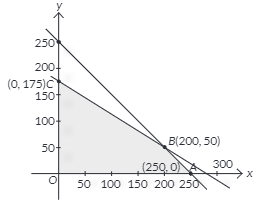
The corner points of the bounded feasible region of an LPP are $O(0,0), A(250,0), B(200,50)$ and $C(0,175)$. If the maximum value of the objective function $Z=2 a x+$ by occurs at the points $A(250,0)$ and $B(200,50)$, then the relation between $a$ and $b$ is:
Image
If the integral  $\int {\frac{{\cos \,8x + 1}}{{\cot \,2x - \tan \,2x}}} dx = A\,\cos \,8x + k,$   where $k$ is an arbitrary constant, then $A$ is equal to
$\int_{}^{} {\frac{{{x^2} + 1}}{{{x^4} + 1}}dx = } $
$\int_{\pi /3}^{\pi /2} {\frac{{\sqrt {1 + \cos x} }}{{{{(1 - \cos x)}^{\frac{5}{2}}}}}} \,dx = $
The angle of intersection of the curves $\text{y}=2\sin^2\text{x}$ and $\text{y}=\cos2\text{x}$ at $\text{x}=\frac{\pi}{6}$ is: