MCQ
$\int\limits^{\pi}_0\frac{1}{1+\sin\text{x}}\text{ dx}$ equals:
  • A
    $0$
  • B
    $\frac{1}{2}$
  • $2$
  • D
    $\frac{3}{2}$

Answer

Correct option: C.
$2$
$\int\limits^{\pi}_0\frac{1}{1+\sin\text{x}}\text{ dx}$
$=\int\limits^\pi_0\frac{1}{1+\sin\text{x}}\times\frac{1-\sin\text{x}}{1-\sin\text{x}}\text{dx}$

$= \int\limits^\pi_0\frac{1-\sin\text{x}}{1-\sin^2\text{x}}\text{dx}$

$= \int\limits^\pi_0\frac{1-\sin\text{x}}{\cos^2\text{x}}\text{dx}$

$=\int\limits^\pi_0(\sec^2\text{x}-\sec\text{x}\tan\text{x})\text{dx}$

$=\big[\tan\text{x}-\sec\text{x}\big]^\pi_0$

$=0+1-0+1$

$=2$

Need a full question paper?

Generate a complete, print-ready paper with questions like this in minutes — across 16+ boards, with answer keys.

Start Generating Free

Similar questions

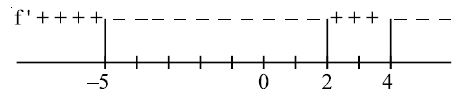
 $(i)$  $f (x)$ is continuous and defined for all real numbers

$(ii)$ $f '(-5) = 0 \,; \,f '(2)$ is not defined and $f '(4)  = 0$

$(iii)$ $(-5, 12)$ is a point which lies on the graph of $f (x)$

$(iv)$ $f ''(2)$ is undefined, but $f ''(x)$ is negative everywhere else.

$(v)$ the signs of  $f '(x)$ is given below

Possible graph of $y = f (x)$ is
A line makes angles $\alpha,\beta,\gamma$ with the positive direction of the axes of reference. The value of $\cos2\alpha+\cos2\beta+\cos2\gamma$ is:
If $\frac{\pi }{2} \le x \le \frac{{3\pi }}{2},$ then ${\sin ^{ - 1}}(\sin x)$ is equal to
Each side of equilateral is increasing at the rate of 8cm/hr. The rate of increase of its area when side 2cm, is:
If $A$ and $B$ are two events such that $P(A) = 0.4, P(B) = 0.3$ and $\text{P}(\text{A}\cup\text{B})=0.5,$ then $\text{P}(\overline{\text{B}}\cap\text{A})$ equals.
Let $f(x)=\left\{\begin{array}{l}x-1, x \text { is even, } \\ 2 x, x \text { is odd, }\end{array}\right.$. If for some $a \in N, f(f(f(a)))=21$, then $\lim _{x \rightarrow a^{-}}\left\{\frac{|x|^3}{a}-\left[\frac{x}{a}\right]\right\}$, where $[t]$ denotes the greatest integer less than or equal to $t$, is equal to :
The domain of $\cos^{-1}\big(\text{x}^2-4\big)$ is:
Choose the correct answer from the given four option.
$\tan^{-1}+\tan^{-1}\text{y}=\text{C}$ is the general solution of the differential equation:
The unit vector parallel to the resultant vector of $2i + 4j - 5k$ and $i + 2j + 3k$ is
Let $f: R \rightarrow R$ be defined as $f(x)=3 x .$ Choose the correct answer.