MCQ
$\int_{\pi /4}^{\pi /2} {{\rm{cose}}{{\rm{c}}^2}xdx = } $
  • A
    $ - 1$
  • $1$
  • C
    $0$
  • D
    $\frac{1}{2}$

Answer

Correct option: B.
$1$
b
(b) $\int_{\pi /4}^{\pi /2} {{\rm{cose}}{{\rm{c}}^2}} x\;dx = \left[ { - \cot x} \right]_{\pi /4}^{\pi /2}$ 

$ = - \left[ {\cot \frac{\pi }{2} - \cot \frac{\pi }{4}} \right] = 1$.

Need a full question paper?

Generate a complete, print-ready paper with questions like this in minutes — across 16+ boards, with answer keys.
Start Generating Free

Similar questions

Area bounded by the curve $y = x{e^{{x^2}}},$ $x - $axis and the ordinates $x = 0,\,\,x = a$
If $\frac{d}{{dx}}\,G\left( x \right) = \frac{{{e^{\tan \,x}}}}{x},\,x \in \left( {0,\pi /2} \right)$, then $\int\limits_{1/4}^{1/2} {\frac{2}{x}} .{e^{\tan \,\left( {\pi \,{x^2}} \right)}}dx$ is equal to
The area bounded by the parabola $x^2=4 y$ and its latus rectum is:
Let $\vec{a}$ and $\overrightarrow{ b }$ be two non-zero vectors perpendicular to each other and $|\overrightarrow{ a }|=|\overrightarrow{ b }| .$ If $|\overrightarrow{ a } \times \overrightarrow{ b }|=|\overrightarrow{ a }|,$ then the angle between the vectors $(\vec{a}+\vec{b}+(\vec{a} \times \vec{b}))$ and $\vec{a}$ is equal to
Let $f(x)$ be a non-negative continous function such that the area bounded by the curve $y = f(x)$, $x -$ axis and the ordinates $x = \frac{\pi }{4}$, $x = \beta > \frac{\pi }{4}$ is $\left( {\beta \sin \beta + \frac{\pi }{4}\cos \beta + \sqrt 2 \beta } \right)$. Then $f\;\left( {\frac{\pi }{2}} \right)$ is
$\left| {\,\begin{array}{*{20}{c}}{x + 1}&{x + 2}&{x + 4}\\{x + 3}&{x + 5}&{x + 8}\\{x + 7}&{x + 10}&{x + 14}\end{array}\,} \right| = $
$\int_{}^{} {{x^3}{e^{{x^2}}}dx = } $
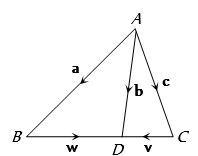
In the figure, a vector $x$  satisfies the equation $x - w = v$. Then $x =$
If $\text{u}=\cot^{-1}\sqrt{\tan\theta}-\tan^{-1}\sqrt{\tan\theta}$ then, $\tan\Big(\frac{\pi}{4}-\frac{\text{u}}{2}\Big)=$
  1. $\sqrt{\tan\theta}$
  2. $\sqrt{\cot\theta}$
  3. $\tan\theta$
  4. $\cot\theta$
Let the area of the region enclosed by the curve $\mathrm{y}=\min \{\sin \mathrm{x}, \cos \mathrm{x}\}$ and the $\mathrm{x}$-axis between $\mathrm{x}=-\pi$ to $\mathrm{x}=\pi$ be $\mathrm{A}$. Then $\mathrm{A}^2$ is equal to...........