Question
$\int\frac{\text{x}+1}{\sqrt{2\text{x}+3}}\text{dx}$

Answer

$\int\Big(\frac{\text{x}+1}{\sqrt{2\text{x}+3}}\Big)\text{dx}$
$=\frac{1}{2}\int\Big(\frac{2\text{x}+2}{\sqrt{2\text{x}+3}}\Big)\text{dx}$
$=\frac{1}{2}\int\Big(\frac{2\text{x}+3-1}{\sqrt{2\text{x}+3}}\Big)\text{dx}$
$=\frac{1}{2}\int\Big(\frac{2\text{x}+3}{\sqrt{2\text{x}+3}}-\frac{1}{\sqrt{2\text{x}+3}}\Big)\text{dx}$
$=\frac{1}{2}\int\Big(\sqrt{2\text{x}+3}-\frac{1}{\sqrt{2\text{x}+3}}\Big)\text{dx}$
$=\frac{1}{2}\Big[\int(2\text{x}+3)^\frac{1}{2}\text{dx}-\int(2\text{x}+3)^{-\frac{1}{2}}\text{dx}\Big]$
$=\frac{1}{2}\Bigg[\frac{(2\text{x}+3)^{\frac{1}{2}+1}}{2\big(\frac{1}{2}+1\Big)}-\frac{(2\text{x}+3)^{-\frac{1}{2}+1}}{2\big(-\frac{1}{2}+1\big)}+\text{C}\Bigg]$
$=\frac{1}{2}\Big[\frac{1}{3}(2\text{x}+3)^\frac{3}{2}-(2\text{x}+3)^\frac{1}{2}+\text{C}\Big]$
$=\frac{1}{6}(2\text{x}+3)^\frac{3}{2}-\frac{1}{2}(2\text{x}+3)^\frac{1}{2}+\text{C}$

Need a full question paper?

Generate a complete, print-ready paper with questions like this in minutes — across 16+ boards, with answer keys.
Start Generating Free

Similar questions

Evaluate the following intregals:
$\int\frac{\text{x}^2+1}{(\text{x}^2+4)(\text{x}^2+25)}\ \text{dx}$
The rate of growth of a population is proportional to the number present. If the population of a city doubled in the past 25 year, and the present population is 100000, when will the city have a population of 500000?
Differentiate the following w. r. t. x.$(\sin x)^{\tan x}-x^{\log x}$
Discuss the continuity of $\text{f(x)}=\sin|\text{x}|$
Find the length and the foot of the perpendicular from the point (1, 1, 2) to the plane $\vec{\text{r}}.\big(\hat{\text{i}}-2\hat{\text{j}}+4\hat{\text{k}}\big)+5=0.$
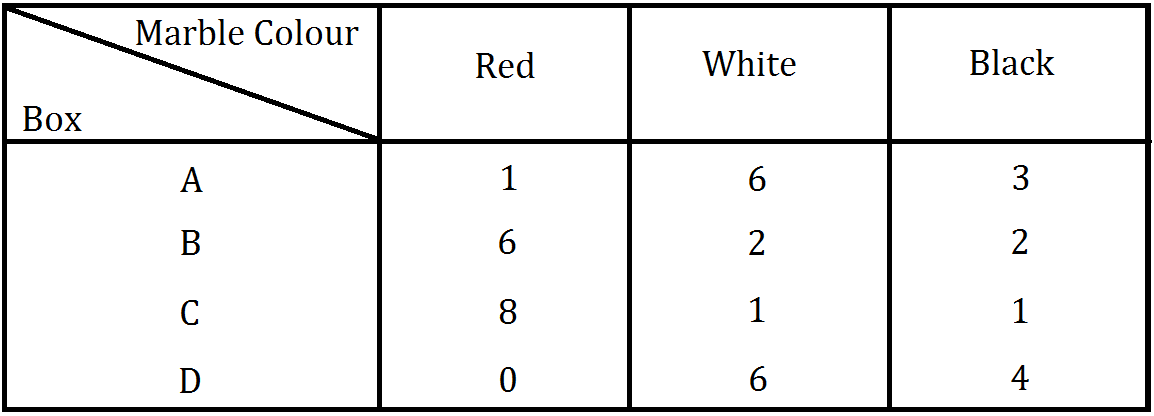
Suppose we have four boxes A, B, C, D containing coloured marbles as given below:
One of the boxes has been selected at random and a single marble is drawn from it. If the marble is red, what is the probability that it was drawn from,
  1. Box A?
  2. Box B?
  3. Box C?
Prove that $y=\frac{4 \sin \theta}{2+\cos \theta}-\theta$ is an increasing function if $\theta \in\left[0, \frac{\pi}{2}\right]$
Solve the following initial value problems:
$\text{x}\frac{\text{dy}}{\text{dx}}-\text{y}=\log\text{x},\text{ y}(1)=0$
ABCD are four points in a plane and Q is the point of intersection of the lines joining the mid-points of AB and CD, BC and AD. Show that $\overrightarrow{\text{PA}}+\overrightarrow{\text{PB}}+\overrightarrow{\text{PC}}+\overrightarrow{\text{PD}}=4\ \overrightarrow{\text{PQ}}$, where P ia any point.
Differentiate the following functions with respect to x:
$(\sin\text{x})^{\cos\text{x}}$