MCQ
Iodine stains:
- APectin
- BLignified regions
- CCellulose
- DStarch.
Explanation:
Iodine is used in chemistry as an indicator for starch. When starch is mixed with iodine in solution, an intensely dark blue colour develops, representing a starch/iodine complex.
Starch is a substance common to most plant cells and so a weak iodine solution will stain starch present in the cells. Iodine is one component in the staining technique known as Gram staining, used in microbiology.
Generate a complete, print-ready paper with questions like this in minutes — across 16+ boards, with answer keys.
(image)
The correct option is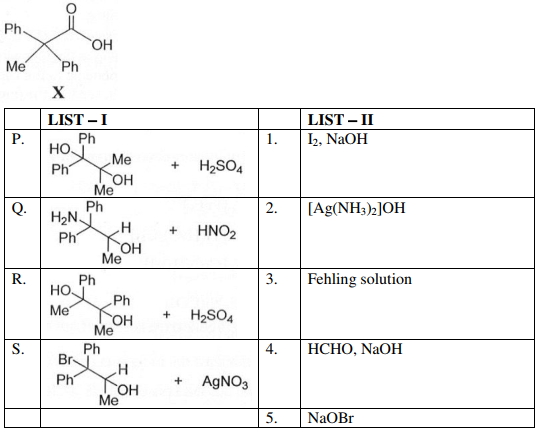
$\begin{array}{*{20}{c}}
{C{H_3} - C \equiv C - C{H_2} - \mathop C\limits_{\mathop {||}\limits_O } - Cl}
\end{array} \ \xrightarrow[{BaS{O_4}}]{{{H_2} - Pd}}$
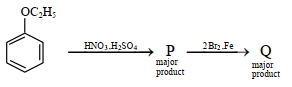
$MnO _{4}^{-}+8 H ^{+}+5 e ^{-} \rightarrow Mn ^{2+}+4 H _{2} O$,
$E^{o} _{ Mn ^{2+} / MnO _{4}^{-}}=-1.510 \,V$
$\frac{1}{2} O _{2}+2 H ^{+}+2 e ^{-} \rightarrow H _{2} O$,
$E _{ O _{2} / H _{2} O }^{o}=+1.223 \,V$
Will the permanganate ion, $MnO _{4}^{-}$liberate $O _{2}$ from water in the presence of an acid ?
$2NO(g) + 2{H_2}(g) \to {N_2}(g) + 2{H_2}O(g)$ is :
Step $1$ : $2NO(g) + {H_2}(g)\xrightarrow{{slow}}{N_2} + {H_2}{O_2}$
Step : $2$ ${H_2}{O_2} + {H_2}\xrightarrow{{fast}}2{H_2}O$
Then the correct statement is