MCQ
Iodine stains:
  • A
    Pectin
  • B
    Lignified regions
  • C
    Cellulose
  • Starch.

Answer

Correct option: D.
Starch.
Iodine is used in chemistry as an indicator for starch. When starch is mixed with iodine in solution, an intensely dark blue colour develops, representing a starch/iodine complex.
Starch is a substance common to most plant cells and so a weak iodine solution will stain starch present in the cells. Iodine is one component in the staining technique known as Gram staining, used in microbiology.

Need a full question paper?

Generate a complete, print-ready paper with questions like this in minutes — across 16+ boards, with answer keys.

Start Generating Free

Similar questions

Reaction of tert.butyl alcohol with hot Cu at $350\,^oC$ produce
$P_A = (235\, y -125\, xy)\, mm\, of\, Hg$. $P_A$ is partial pressure of $A$, $x$ is mole fraction of $B$ in liquid phase in the mixture of two liquids $A$ and $B$ and $y$ is the mole fraction of $A$ in vapour phase, then $P^o_B$ in $mm\, of\, Hg$ is
Match the complexes in Column-$I$ with their properties listed in Column-$II$. Indicate your answer by darkening the appropriate bubbles of the $4 \times 4$ matrix given in the $ORS$.
Column-$I$ Column-$II$
$(A)$ $\left[\mathrm{Co}\left(\mathrm{NH}_3\right)_4\left(\mathrm{H}_2 \mathrm{O}\right)_2\right] \mathrm{Cl}_2$ $(p)$ geometrical isomers
$(B)$ $\left[\mathrm{Pt}\left(\mathrm{NH}_3\right)_2 \mathrm{Cl}_2\right]$ $(q)$ paramagnetic
$(C)$ $\left[\mathrm{Co}\left(\mathrm{H}_2 \mathrm{O}\right)_5 \mathrm{Cl}\right] \mathrm{Cl}$ $(r)$ diamagnetic
$(D)$ $\left[\mathrm{Ni}\left(\mathrm{H}_2 \mathrm{O}\right)_6\right] \mathrm{Cl}_2$ $(s)$ metal ion with $+2$ oxidation state
Crystal field splitting energy for high spin $d^4$ octahedral complex is
In the reaction, ${C_6}{H_5}CHO + {(C{H_3}CO)_2}O\xrightarrow{{C{H_3}COONa}}(A)$ product $(A)$ is
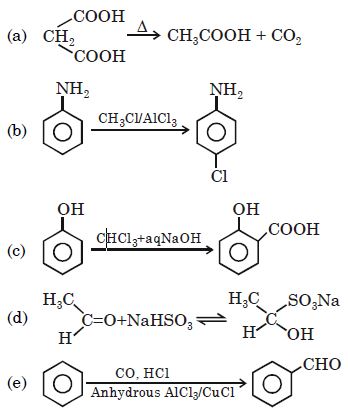
Which of the following reaction is incorrect
Which has the lowest boiling point
Aldehydes and ketones can be reduced to corresponding hydrocarbons by
For there action of $H_2$ with $I_2,$ the rate constant is $2.5\times 10^{-4}\,dm^3\,mol^{-1}\,s^{-1}$ at $327\,^oC$ and $1.0\,dm^3\,mol^{-1}\,s^{-1}$ at $527\,^oC$. The activation energy for the reaction, in $kJ\,mol^{-1}$ is: $(R = 8.314\,J\,K^{-1}\,mol^{-1} )$
Which of the following procedures would be best for achieving the following reaction ?