MCQ
Ionic molecules are:
  • Polar molecules.
  • B
    Non polar molecules.
  • C
    Both a and b.
  • D
    None.

Answer

Correct option: A.
Polar molecules.

Need a full question paper?

Generate a complete, print-ready paper with questions like this in minutes — across 16+ boards, with answer keys.
Start Generating Free

Similar questions

In a decaying $L-R$ circuit, the time after which energy stored in the inductor reduces to one-fourth of its intitial value is
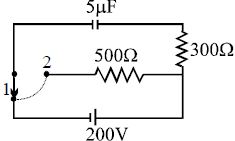
A capacitor of capacitance $5\,\mu F$ is connected to a source of constant $emf$ of $200\,V$ for a long time, then the switch was shifted to contact $2$ from contact $1$ . The total amount of heat generated in the $500\,\Omega $ resistance, thereafter is
The hottest planet of solar system is
One conducting $U$ tube can slide inside another as shown in figure, maintaining electric contacts between the tubes. The magnetic field $B$ is perpendicular to the plane of the figure. If each tube moves towards the other at a constant speed $v$, then the emf induced in the circuit in terms of $B, l $ and $v$ where $l$ is the width of each tube, will be
Which of the following is the best definition of the uncertainty principle?
A closely wound flat circular coil of 25 turns of wire has diameter of 10 cm and carries a current of 4 ampere. Determine the flux density at the centre of a coil
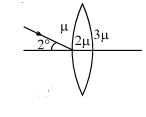
$A$ light ray hits the pole of a thin biconvex lens as shown in figure. The angle made by the emergent ray with the optic axis will be
Electric charges of +10μC, + 5μC, -3μC and +8 μC are placed at the corners of a square of side $\sqrt 2$ m. the potential at the centre of the square is 
An electron of mass $m _{ e }$ and a proton of mass $m _{ p }=1836 m _{ e }$ are moving with the same speed. The ratio of their de Broglie wavelength $\frac{\lambda_{\text {electron }}}{\lambda_{\text {proton }}}$ will be ....... .
Two long thin charged rods with charge density $\lambda$ each are placed parallel to each other at a distance $d$ apart. The force per unit length exerted on one rod by the other will be $\left(\right.$ where $\left.k=\frac{1}{4 \pi \varepsilon_0}\right)$