MCQ
Ionization energy increases in the order
  • A
    $Be,\,B,\,C,\,N$
  • $B,\,Be,\,C,\,N$
  • C
    $C,\,N,\,Be,\,B$
  • D
    $N,\,C,\,Be,\,B$

Answer

Correct option: B.
$B,\,Be,\,C,\,N$
b
(b) $B, Be, C, N$ as $I.E.$ increases across the period.

Need a full question paper?

Generate a complete, print-ready paper with questions like this in minutes — across 16+ boards, with answer keys.
Start Generating Free

Similar questions

Heisenberg uncertainity principle is not valid for
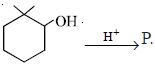
The product $P$ is :
Benzamide on reaction with $POC{l_3}$ gives
Which of the following is not an element
For hydrogen atom, energy of an electron in first excited state is $-3.4 \mathrm{eV}, \mathrm{KE}$. of the same electron of hydrogen atom is $\mathrm{x} \mathrm{eV}$. Value of $\mathrm{x}$ is. . . . . . .$\times 10^{-1} \mathrm{eV}$. (Nearest integer)
An example for a strong electrolyte is
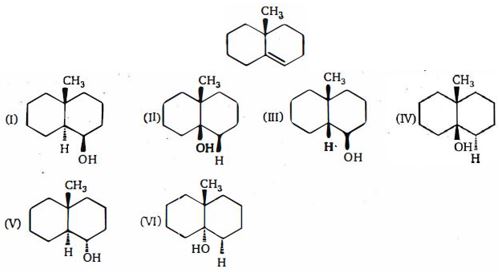
What are the products obtained on hydroboration-oxidation of the given alkene
$200\, \mathrm{~mL}$ of $0.2\, \mathrm{M} \mathrm{HCl}$ is mixed with $300\, \mathrm{~mL}$ of $0.1\, \mathrm{M} \mathrm{NaOH}$. The molar heat of neutralization of this reaction is $-57.1 \,\mathrm{~kJ}$. The increase in temperature in ${ }^{\circ} \mathrm{C}$ of the system on mixing is $\mathrm{x} \times 10^{-2}$. The value of $\mathrm{x}$ is ....... . (Nearest integer)

[Given : Specific heat of water $=4.18\, \mathrm{~J} \,\mathrm{~g}^{-1}\, \mathrm{~K}^{-1}$

Density of water $=1.00\, \mathrm{~g}\, \mathrm{~cm}^{-3}$ ]

(Assume no volume change on mixing)

Both ionic and covalent bond is present in the following
Based on the following thermochemical equations

${H_2}O\left( g \right) + C\left( s \right) \to CO\left( g \right) + {H_2}\left( g \right);\Delta H = 131\,kJ$

$CO\left( g \right) + \frac{1}{2}{O_2}\left( s \right) \to C{O_2}\left( g \right);\Delta H =  - 282\,kJ$

${H_2}\left( g \right) + \frac{1}{2}{O_2}\left( s \right) \to {H_2}O\left( g \right);\Delta H =  - 242\,kJ$

$C(s) + O_2(g) \to CO_2(g); \Delta H = X\,kJ$

The value of $X$ will be......$kJ$