MCQ
Ionization energy is highest for
  • Noble gases
  • B
    Platinum metals
  • C
    Transition elements
  • D
    Inner–transition elements

Answer

Correct option: A.
Noble gases
a
(a)As the ${e^ - }$ is to be removed from stable configuration.

Need a full question paper?

Generate a complete, print-ready paper with questions like this in minutes — across 16+ boards, with answer keys.

Start Generating Free

Similar questions

Octet rule is not valid for the molecule
Orbital interaction between the sigma bonds of a substitutent group and a neighbouring pi orbital is known as
An organic compound answers Molisch's test as well as Benedict's test. But it does not answer Scliwanoff's test. Most probably, it is
$Zn(s) + C{l_2}(1\;{\rm{atm)}} \to {\rm{Z}}{{\rm{n}}^{{\rm{2}} + }} + 2C{l^ - }$. ${E^0}_{cell}$ of the cell is $ 2.12\,V$ To increase $E$
Which of the reagent is used to convert $2$ -Butanone into propanoic acid :-
Which of the following complexes will show  geometrical isomerism?
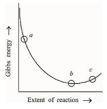
Consider the graph of $G i b b s$ free energy $G$ vs Extent of reaction. The number of statement/s from the following which are true with respect to points $(a), (b)$ and $(c)$ is $.................$

$A.$Reaction is spontaneous at $(a)$ and $(b)$

$B.$Reaction is at equilibrium at point $(b)$ and nonspontaneous at point $(c)$

$C.$Reaction is spontaneous at $(a)$ and nonspontaneous at $(c)$

$D.$Reaction is non-spontaneous at $(a)$ and $(b)$
The maximum number of possible isomers (including stereoisomers) which may be formed on mono-bromination of $1$-methylcyclohex-1-ene using $Br _2$ and $UV$ light is. . . . . .
Assign $A, B, C, D$ from given type of reaction. $NO + N{O_2}\xrightarrow{{ - 11\,{}^oC}}{N_2}{O_3}$
For a double strand $DNA$, one strand is given below:

The amount of energy required to split the double strand $DNA$ into two single strands is . . . .kcal $mol ^{-1}$.

[Given: Average energy per $H$-bond for $A - T$ base pair $=1.0 kcal mol ^{-1}, G - C$ base pair $=1.5 kcal mol ^{-1}$, and $A - U$ base pair $=1.25 kcal mol ^{-1}$. Ignore electrostatic repulsion between the phosphate groups.]
