Question
Is a slow process always isothermal? ls a quick process always adiabatic?

Answer

As PV directly proportional to constant in isothermal process.
Thus volume varies slowly w.r.t pressure.
As in adiabatic process the volume decreases as PV directly proportional to constant.
So, isothermal process is slow process and adiabatic process is fast process.

Need a full question paper?

Generate a complete, print-ready paper with questions like this in minutes — across 16+ boards, with answer keys.
Start Generating Free

Similar questions

State the principle of working of a cyclotron. Write two uses of this machine.
Electric charge is distributed in a small volume. The electric flux passing through a total charge enclosed by a spherical surface of radius 10 cm is 10 Vm . Then what will be the flux associated with a concentric sphere of radius 20 cm ?
State Lenz’s Law.
A metallic rod held horizontally along east-west direction, is allowed to fall under gravity. Will there be an emf induced at its ends? Justify your answer.
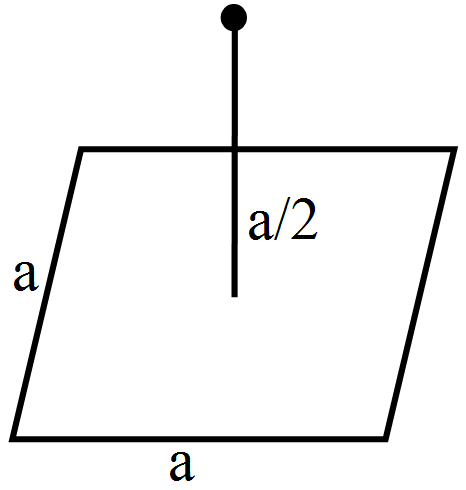
A charge $Q$ is placed at a distance $\frac{\text{a}}{2}$ above the centre of a horizontal, square surface of edge a as shown in figure. Find the flux of the electric field through the square surface.
The yield point of a typical solid is about 1%. Suppose you are lying horizontally and two persons are pulling your hands and two person are pulling your legs along your own length. How much will be the increase in your length if the strain is 1%? Do you think your yield point is 1% or, much less than that?
Write a short note on visible rays.
In the decay $^{64}\ce{Cu \rightarrow ^{64}Ni + e^+ + v}, $ the maximum kinetic energy carried by the positron is found to be $0.650MeV.$
  1. What is the energy of the neutrino which was emitted together with a positron of kinetic energy $0.150MeV$?
  2. What is the momentum of this neutrino in $kg-m/s$ ?
Use the formula applicable to a photon.
Explain the photoelectric effect when the radiation is incident on different metals?
Infinite charges of $1 \mu C$ are placed on the x -axis at the positions $x=1,2,4,8, \ldots \infty$. If a charge of 1 C is situated at the origin, then find the value of the total force applied on it.
Using the formula $\overrightarrow{\text{F}}=\text{q}\overrightarrow{\text{v}}\times\overrightarrow{\text{B}}$ and $\text{B}=\frac{\mu_0\text{i}}{2\pi\text{r}},$ show that the $SI$ units of the magnetic field $B$ and the permeability constant $\mu_0$ may be written as $N/A-m$ and $NA^2$ respectively.