Question
Is a slow process always isothermal? ls a quick process always adiabatic?

Answer

As PV directly proportional to constant in isothermal process. Thus volume varies slowly w.r.t pressure. As in adiabatic process the volume decreases as PV directly proportional to constant. So, isothermal process is slow process and adiabatic process is fast process.

Need a full question paper?

Generate a complete, print-ready paper with questions like this in minutes — across 16+ boards, with answer keys.

Start Generating Free

Similar questions

Light from Balmer series of hydrogen is able to eject photoelectrons from a metal. What can be the maximum work function of the metal?
A car of mass 1000 kg moving with a speed of $30 \mathrm{~ms}^{-1}$ collides with the back of a stationary lorry of mass 9000 kg . (Fig.).Calculate the speed of the vehicles immediately after the collision if they remain jammed together.
In which case centre of mass of a body lie outside it? Give one example.
Explain how an object could have zero average velocity but non-zero average speed?
Determine the speed with which the earth has to rotate on its axis so that a person on the equator weigh $\Big(\frac{3}{5}\Big)^{\text{th}}$ as much as at present. Take the equatorial radius as 6400km.
Explain the difference between uniform velocity and variable velocity.
Name one system where the compressional and tensional modulus of elasticity are different. Give reason.
A bus starting from rest moves with a uniform acceleration of $0.1m/s^2$ for $2$ min. Find:
  1. The speed acquired.
  2. The distance travelled.
Rain is falling vertically. A man running on the road keeps his umbrella tilted but a man standing on the street keeps his umbrella vertical to protect himself from the rain. But both of them keep their umbrella vertical to avoid the vertical sun-rays. Explain.
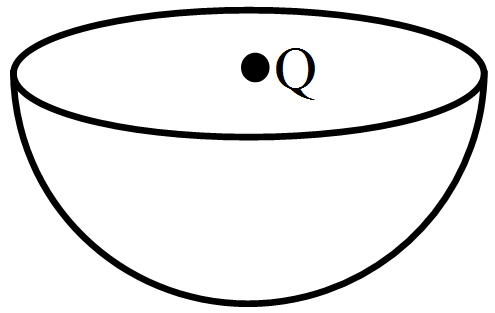
A charge Q is placed at the centre of an imaginary hemispherical surface. Using symmetry arguments and the Gauss's law, find the flux of the electric field due to this charge through the surface of the hemisphere (figure).