Question
Is a slow process always isothermal? ls a quick process always adiabatic?

Answer

As PV directly proportional to constant in isothermal process.
Thus volume varies slowly w.r.t pressure.
As in adiabatic process the volume decreases as PV directly proportional to constant.
So, isothermal process is slow process and adiabatic process is fast process.

Need a full question paper?

Generate a complete, print-ready paper with questions like this in minutes — across 16+ boards, with answer keys.
Start Generating Free

Similar questions

Light falls from glass $(\mu=1.5)$ to air. Find the angle of incidence for which the angle of deviation is 90°.
Two identical metal spheres of exactly equal mass have been taken. One is charged with negative charge say q and the other with the same amount of positive charge. Will there be any difference in the mass of the two spheres? If yes then why?
The radii of two conductors $A$ and $B$ with equal charge density are $R_1$ and $R_2$, respectively ( $R_1$ $>R_2$ ). If the conductors are connected to a conducting wire of negligible capacitance then find out :(a) From which conductor will the charge flowto whom?(b) What will be the ratio of charges on the conductors after charge redistribution?
An electron moves in a circular orbit $6^{15} \times 10^{15}$ times per second. Find the magnitude of current in the loop.
Which one of the following will describe the smallest circle when projected with the same velocity v perpendicular to the magnetic field B: (i) $\alpha$-particle, and (ii) $\beta$-particle?
Define current sensitivity and voltage sensitivity of a galvanometer.
Increasing the current sensitivity may not necessarily increase the voltage sensitivity of a galvanometer. Justify.
57Co decays to 57Fe by $\beta^+-\text{ emission.}$- emission. The resulting 57Fe is in its excited state and comes to the ground state by emitting $\gamma-\text{rays}.$ The half-life of $\beta^+-\text{decay}$ is 270 days and that of the $\gamma-\text{emissions}$ is 10-8 s. A sample of 57Co gives 5.0 × 10⁹ gamma rays per second. How much time will elapse before the emission rate of gamma rays drops to 2.5 × 10⁹per second?
A semiconductor has equal electron and hole concentration of 6 × 10⁸/m3. On doping with certain impurity, electron concentration increases to 9 × 10¹²/m3.
  1. Identify the new semiconductor obtained after doping.
  2. Calculate the new hole concentration.
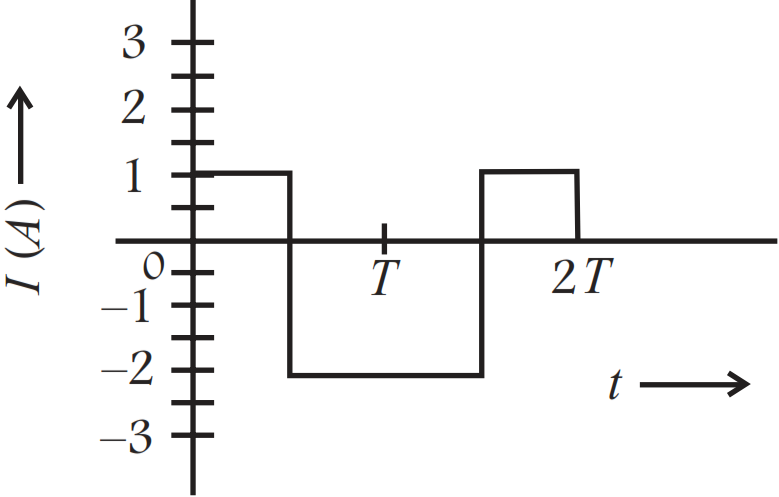
The alternating current in a circuit is described by the graph shown in Fig. Show rms current in this graph.

Find an expression for intensity of transmitted light when a polaroid sheet is rotated between two crossed polaroids. In which position of the polaroid sheet will the transmitted intensity be maximum?