Question
Is a vector necessarily changed if it is rotated through an angle?

Answer

Not necessarily, a vector changes if it is rotated through any angle except for $2\pi,4\pi,6\pi, \ ...$ radians”

Need a full question paper?

Generate a complete, print-ready paper with questions like this in minutes — across 16+ boards, with answer keys.
Start Generating Free

Similar questions

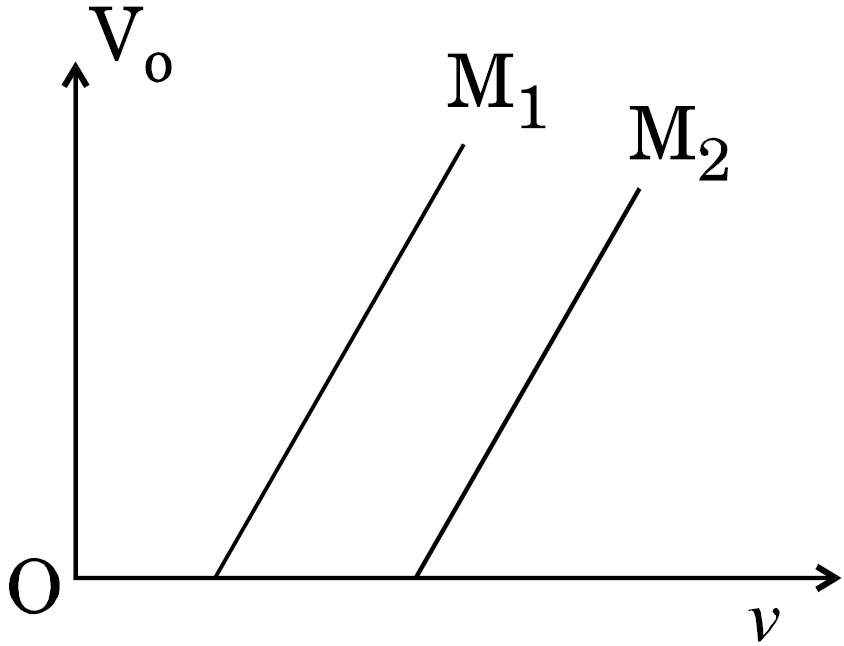
The variation of the stopping potential $(V_0)$ with the frequency (v) of the light incident on two different photosensitive surfaces $M_1$ and $M_2$ is shown in the figure. Identify the surface which has greater value of the work function.
Find the dimensional formula of $\in_0.$
Name electromagnetic waves which are: (a) Helpful in relaxing the muscles. (b) Absorbed by the ozone layer in the atmosphere.
Two blocks of masses 10kg and 20kg moving at speeds of $10ms^{-1}$ and $20ms^{-1}$ respectively in opposite directions, approach each other and collide. If the collision is completely inelastic, find the thermal energy developed in the process.
With increase in temperature, will the drift velocity of free electrons in a metallic conductor increase or decrease?
When a body is weighed on an ordinary balance we demand that the arm should be horizontal if the weights on the two pans are equal. Suppose equal weights are put on the two pans, the arm is kept at an angle with the horizontal and released. Is the torque of the two weights about the middle point (point of support) zero? Is the total torque zero? If so, why does the arm rotate and finally become horizontal?
The coercive force for a certain permanent magnet is $4.0 × 10^4\ A/m.$Thia magnet is placed inside a long solenoid of 40 turns/cm and a current is passed in the solenoid to demagnetise it completely. Find the current.
Which of the following radiations are:
  1. Heat radiation,
  2. Used for long distance transmission? Infrared rays, gamma rays, ultraviolet rays, microwaves.
An inductor and a resistor are joined in series with any ac source. What is the phase difference in the potential difference across their ends?
If on converting galvanometer of resistance G into ammeter, 1% of main current passes through the galvanometer, then what is the resistance of the shunt?