Question
Is it necessary to have two waves of equal intensity to study interference pattern? Will there be an effect on clarity if the waves have unequal intensity?

Answer

Interference pattern can be studied with waves of unequal intensity.$\text{I}=\text{I}_1+\text{I}_2+2\sqrt{[\text{I}_1\times\text{I}_2]}\cos(\phi),$
Where $\phi$, = phase difference. In case of waves of unequal intensities, the contrast will not be clear, as the minima will not be completely dark.

Need a full question paper?

Generate a complete, print-ready paper with questions like this in minutes — across 16+ boards, with answer keys.
Start Generating Free

Similar questions

For a photosensitive surface, threshold wavelength is $\lambda_0.$ Does photoemission occur if the wavelength of radiation is (i) more than $\lambda_0$ and (ii) less than $\lambda_0?$ Justify your answer.
The radii of curvature of the faces of a double convex lens are 10 cm and 15 cm. If focal length of the lens is 12 cm, find the refractive index of the material of the lens.
At a hydroelectric power plant, the water pressure head is at a height of $300m$ and the water flow available is $100\ m^3s^{–1}.$ If the turbine generator efficiency is $60\%$, estimate the electric power available from the plant $(g = 9.8\ ms^{–2}).$
Define electric field intensity and equipotential surface in current carrying conductor.
The decay constant of $\text{ }^{197}_{80}\text{Hg} ($electron capture to $\text{ }^{197}_{79}\text{Au})$ is $1.8 \times 10^{-4} S^{-1}.$
  1. What is the half-life$?$
  2. What is the average-life$?$
  3. How much time will it take to convert $25\%$ of this isotope of mercury into gold$?$
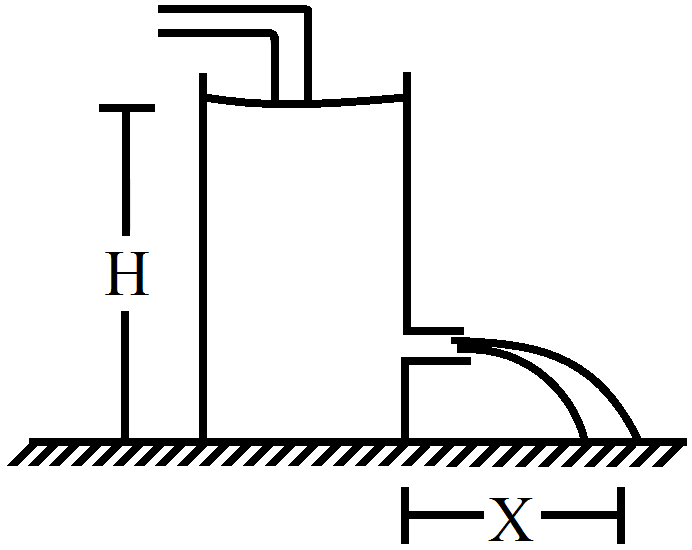
Water level is maintained in a cylindrical vessel upto a fixed height H. The vessel is kept on a horizontal plane. At what height above the bottom should a hole be made in the vessel so that the water stream coming out of the hole strikes the horizontal plane at the greatest distance from the vessel.
Define trans conductance of a transistor.
Two point charges, $q_1 = 10 \times 10^{–8} C$ and $q_2 = – 2 \times 10^{–8} C$ are separated by a distance of $60 \ cm$ in air.
  1. Find at what distance from the $1^{st}$ charge, $q_1$ would the electric potential be zero.
  2. Also calculate the electrostatic potential energy of the system.
You are standing with your bag in your hands, on the ice in the middle of a pond. The ice is so slippery that it can offer no friction. How can you come out of the ice?
A short bar magnet placed with its axis at $30^{\circ}$ with a uniform external magnetic field of 0.25 T experiences a torque of magnitude equal to $4.5 \times 10^{-2} J$. What is the magnitude of magnetic moment of the magnet?