Question
Is it necessary to have two waves of equal intensity to study interference pattern? Will there be an effect on clarity if the waves have unequal intensity?

Answer

Interference pattern can be studied with waves of unequal intensity.
$\text{I}=\text{I}_1+\text{I}_2+2\sqrt{[\text{I}_1\times\text{I}_2]}\cos(\phi),$
Where $\phi$, = phase difference.
In case of waves of unequal intensities, the contrast will not be clear, as the minima will not be completely dark.

Need a full question paper?

Generate a complete, print-ready paper with questions like this in minutes — across 16+ boards, with answer keys.
Start Generating Free

Similar questions

Explain ray of light and beam of light.
Explain characteristics of electric charge.
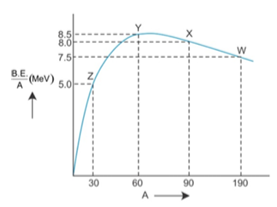
Binding energy per nucleon vs mass number curve for nuclei is shown in the figure. W, X, Y and Z are four nuclei indicated on the curve. Identify which of the following nuclei is most likely to undergo
(i) Nuclear Fission
(ii) Nuclear Fusion.
Justify your answer.

Image
Let $\overrightarrow{\text{A}}=5\vec{\text{i}}-4\vec{\text{j}}$ and $\overrightarrow{\text{B}}=-7.5\vec{\text{i}}+6\vec{\text{j}}.$
  1. Do we have $\overrightarrow{\text{B}}\text{k}\vec{\text{A}}?$
  2. Can we say $\frac{\overrightarrow{\text{B}}}{\overrightarrow{\text{A}}}=\text{k}?$
If an electric dipole is placed at an angle of $30^{\circ}$ to an electric field of intensity $2 \times 10^5 N / C$, a torque of 4 Nm is applied on it. If the length of the dipole is 2 cm , then what will be charge?
Draw and explain the phasor diagram and the graph of $v$ and $i$ versus $\omega$t, for an AC circuit having pure inductor.
Two magnetic poles, one of which is 10 times as strong as the other, exert on each other a force equal to 9.604 mN , when placed 10 cm apart in air. Find the strength of the two poles.
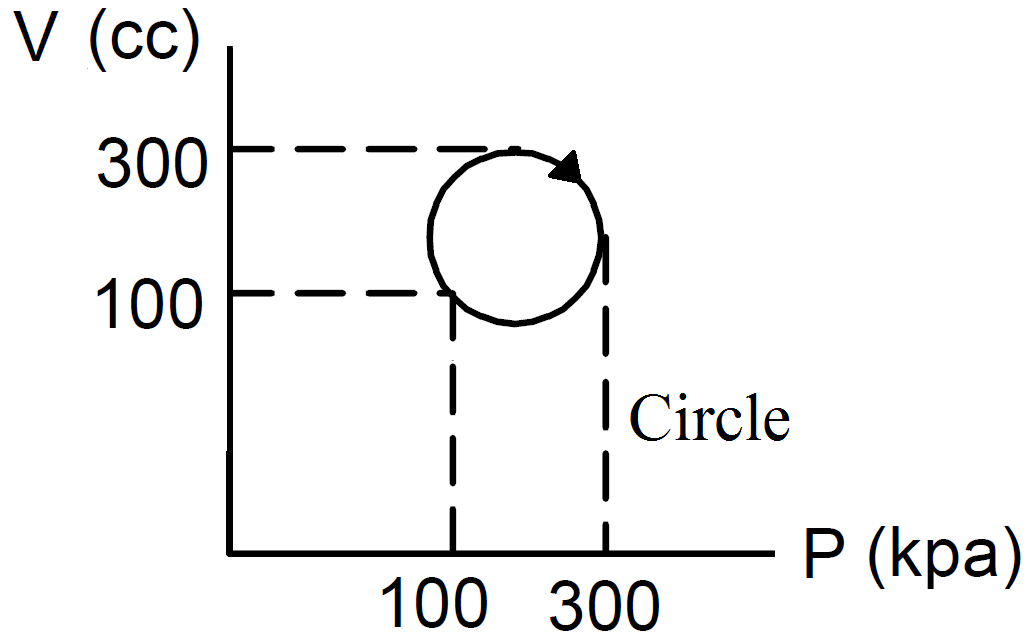
Calculate the heat absorbed by a system in going through the cyclic process shown in figure.

The minimum deviations suffered by red, yellow and violet beams passing through an equilateral transparent prism are 38.4°, 38.7° and 39.2° respectively. Calculate the dispersive power of the medium.
Two towers on top of two hills are 40 km apart. The line joining them passes 50 m above a hill halfway between the towers. What is the longest wavelength of radio waves, which can be sent between the towers without appreciable diffraction effects?