Question
Is it possible to have length and velocity both as fundamental quantities? Why?

Answer

No, since length is fundamental quantity and velocity is the derived quantity.

Need a full question paper?

Generate a complete, print-ready paper with questions like this in minutes — across 16+ boards, with answer keys.
Start Generating Free

Similar questions

A body of mass 2kg initially at rest moves under the action of an applied horizontal force of 7N on a table with coefficient of kinetic friction = 0.1. Compute the:
Change in kinetic energy of the body in 10s.
A particle is executing S.H.M. Identify the positions of the particle where:
  1. K.E. of the particle is zero.
  2. P.E. is zero.
  3. P.E. is one fourth of the total energy.
  4. P.E. and K.E. are equal.
When a body accelerates by $\alpha \text{ t},$ what is the velocity after time 't', when it starts from rest?
If, in Exercise 5.21, the speed of the stone is increased beyond the maximum permissible value, and the string breaks suddenly, which of the following correctly describes the trajectory of the stone after the string breaks:
  1. The stone moves radially outwards.
  2. The stone flies off tangentially from the instant the string breaks.
  3. The stone flies off at an angle with the tangent whose magnitude depends on the speed of the particle?
Angle of friction which the resultant of limiting friction and normal reaction makes with the normal, is numerically equal to ______.
Underline the correct alternative:
In an inelastic collision of two bodies, the quantities which do not change after the collision are the total kinetic energy/ total linear momentum/ total energy of the system of two bodies.
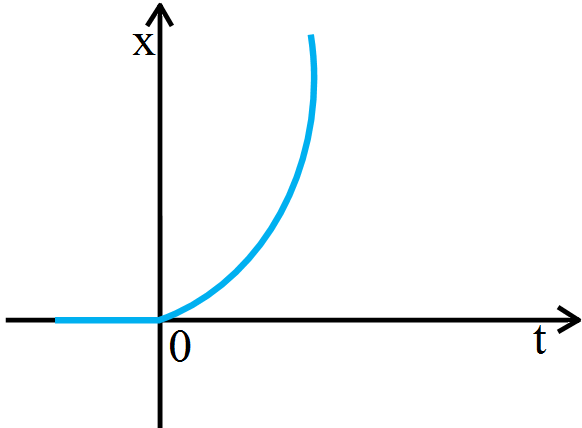
Shows the x-t plot of one-dimensional motion of a particle. Is it correct to say from the graph that the particle moves in a straight line for t < 0 and on a parabolic path for t > 0? If not, suggest a suitable physical context for this graph.

A thermos flask containing tea is shaken vigorously considering tea as a system.
  1. Has heat been added to tea?
  2. Has work been done on it?
  3. Has its internal energy changed?
  4. Does its temperature rise?
Do rain drops fall with uniform velocity or with uniform acceleration?
Boiling of water at its boiling point is an example of which process?