Question
Is it possible to increase the temperature of a gas without adding heat to it? Explain.

Answer

Yes, it is possible to increase the temperature of a gas without adding heat to it, during adiabatic compression the temperature of a gas increases while no heat is given to it. For an adiabatic compression, no heat is given or taken out in adiabatic process. Therefore,$\Delta\text{Q}=0$ According to the first law of thermodynamics, $\Delta\text{Q}=\Delta\text{U}+\Delta\text{W}$$\Delta\text{U}=-\Delta\text{W}(\Delta\text{Q}=0)$
In compression work is done on the gas, i.e. work done is negativ. Therefore, $\Delta\text{U}=$ positive. Hence, internal energy of the gas increases due to which its temperature increases.

Need a full question paper?

Generate a complete, print-ready paper with questions like this in minutes — across 16+ boards, with answer keys.
Start Generating Free

Similar questions

Find (i) the radius of gyration and (ii) the moment of inertia of a rod of mass $100g$ and length $100cm$ about an axis passing through its centre and perpendicular to its length.
  1. State the theorem of parallel axis. Using it derive an expression to find the moment of inertia of a rod of mass M, length 1 about an axis perpendicular to it passing through one of its ends.
  2. Find the centre of mass of a uniform L shaped lamina (a thin flat plate) with dimension as shown in fig. The mass of lamina is $3kg$.
A parallel-plate capacitor with plate area $20cm^2$ and plate separation 1.0mm is connected to a battery. The resistance of the circuit is $10\text{k}\Omega.$ Find the time constant of the circuit.
Show that there are two values of time for a projectile when it is at same height. Also show that the sum of these two times is equal to the time of flight.OR
Prove the following relations by calculus method:
  1. $\text{s}=\text{ut}+\frac{1}{2}\text{at}^2$
  2. $\text{v}^2-\text{u}^2=2\text{as}$
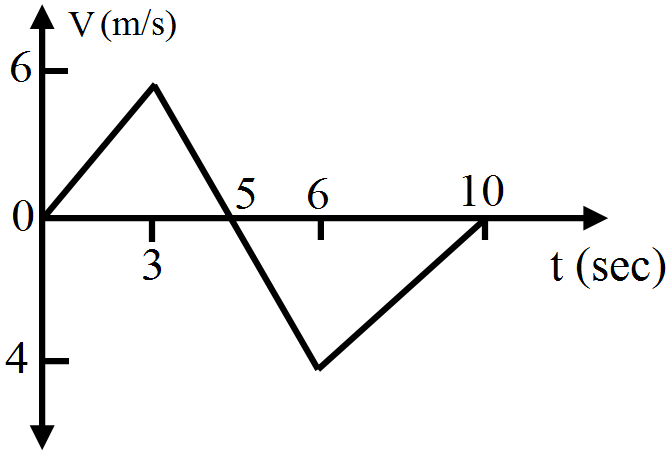
Find the displacement and distance travelled by a body in 10 seconds, using the v - t graph given below:
Define impulse. A cricket ball of mass $150gm$ moving with speed of $12m/ s$ is hit by a bat so that the ball is turned back with a velocity of $20m/ s$. Calculate the impulse received by the ball.
One mole of an ideal gas is taken in a Carnot engine working between $27°C$ and $227°C$. The useful work done in one cycle is $600J$. Calculate the ratio of the volume of the gas at the end and beginning of the isothermal expansion. Given $R = 8.31J mole^{-1} K^{-1}$.
A particle executes the motion described by $\text{x}(\text{t})=\text{x}_0(1-\text{e}^{-\gamma\text{t}});\text{t}\ge0,\text{x}_0>0.$ Find maximum and minimum values of x(t), v(t), a(t). Show that x(t) and a(t) increase with time and v(t) decreases with time.
Two rods of the same area of cross-section, but of lengths $l_1$ and $l_2$ and conductivities $K_1$ and $K_2$ are joined in series. Show that the combination is equivalent of a material of conductivity, $\text{K}=\frac{\text{l}_1+\text{l}_2}{\Big(\frac{\text{l}_1}{\text{K}_1}\Big)\Big(\frac{\text{l}_2}{\text{K}_2}\Big)}$
Calculate the heat required to convert $3kg$ of ice at $-12^\circ C$ kept in a calorimeter to steam at $100^\circ C$ at atmospheric pressure.
Given specific heat capacity of ice $= 2100 \ J \ kg^{-1} \ K^{-1}$,
specific heat capacity of water $= 4186 \ J \ kg^{-1}\ K^{-1}$,
latent heat of fusion of ice $= 3.35 \times 10^5  \ J \ kg^{-1}$
and latent heat of steam $= 2.256 \times 10^6 \ J \ kg^{-1}$. (No heat is absorbed by the calorimeter).