Question
Is ozone depletion related to global warming?

Answer

Ozone depletion and global warming are separate problems, though some agents contribute to both. Chlorofluorocarbons (CFCs) are the principle cause of ozone depletion, but they also happen to be potent heat-trapping gases. Still, CFCs are responsible for less than 10 per cent of total atmospheric warming, far less than the 63 percent contribution of carbon dioxide. Thus, attention paid to CFCs has been on their ozone depletion role. This will change as CFCs are phased out and replaced by hydro chlorofluorocarbons (HCFCs) and hydro fluorocarbons (HFCs such as R-134a). These chemicals have little or no effect on the ozone layer but are strong heat-trapping gases. As their concentration in the atmosphere is already rising, the likely net effect in the future is that reductions in the CFC-related contribution to global warming will be offset by the presence of HCFCs and HFCs
Need a full question paper?

Generate a complete, print-ready paper with questions like this in minutes — across 16+ boards, with answer keys.

Start Generating Free

Similar questions

A homozygous tall plant (TT) bearing red coloured $(R R)$ flowers is crossed with a homozygous dwarf plant (tt) bearing white flowers (rr) :
(i) Give the genotype and phenotype of the $F_1$ generation.
(ii) Give the possible combinations of the gametes that can be obtained from the $F_1$ hybrid.
(iii) Give the dihybrid ratio and the phenotype of the offspring of $F_2$ generation when two plants of above $F_1$ generation are crossed.
Match the terms given in column I with terms in Column II:
Column IColumn Il
(i) Left-auricle(a) Clotting
(ii) Right auricle(b) Thebasius valve
(iii) Left ventricle(c) Pulmonary vein
(iv) Right-ventricle(d) Aorta
(v) Fibrin(e) Pulmonary arch
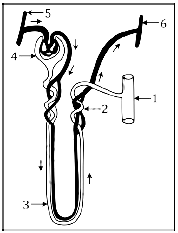
The given diagram represents a nephron and its blood supply. Study the diagram and answer the following questions:
(i) Label parts 1, 2, 3 and 4.
(ii) State the reason for the high hydrostatic pressure in the glomerulus.
(iii) Name the blood vessel which contains the least amount of urea in this diagram.
(iv) Name the two main stages of urine formation.
(v) Name the part of the nephron which lies in the renal medulla.
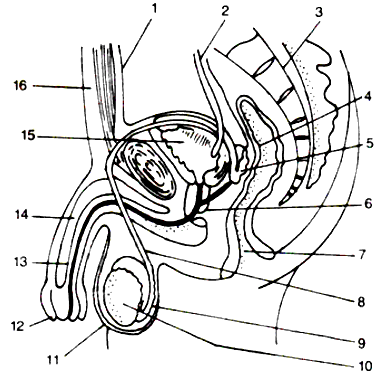
Given on the right is a diagram which represents the reproductive organs of a man:
(i) Write the names of the parts numbered 1 to 16.
(ii) Give two functions of the part 6.
(iii) Name three components of the fluid which may be found in the tube labeled 2.
(iv) What is the main function of the part labelled 3?
Describe fully one experiment with potted green plant to show that starch is not produced in the leaves when carbon dioxide is not available (diagrams essential)
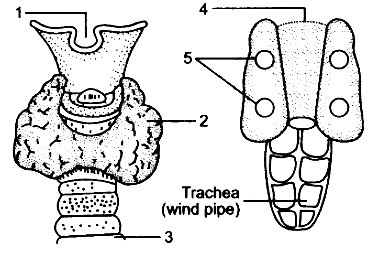
Given alongside are the diagrammatic sketches of some endocrine glands. Observe the figures and answer the following questions:
(i) Label the parts numbered 1 to 5.
(ii) Name the hormones secreted by (2) and (5).
(iii) Which chemicals in our body are greatly affected by hormones?
(iv) What is the chemical nature of hormones?
(v) Name the elements related to the functioning of hormones secreted by the structure (2) and (5).
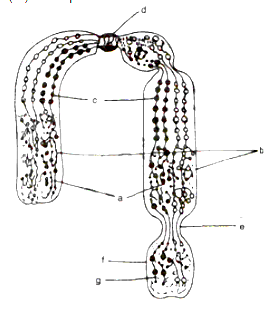
Label the lettered parts of the given figure and answer the following questions:
(i) What does this diagram represent?
(ii) What is the importance of'd'?
(iii) What are the 'staining' properties of 'b' and 'c'?
(iv) Who gave the term used for this structure today?
(v) What is a?
(vi) Is 'e' present in all chromosomes?
Briefly discuss the Theory of Natural Selection as given by Darwin.
List the advantages of having small families.
How is root hair adapted for the absorption of water from the soil?