Question
Is $\text{p}=\frac{\text{E}}{\text{c}}$ valid for electrons?

Answer

From Einstein's mass- energy equation,

$\text{E}=\text{mc}^2$

$\Rightarrow\text{E}=\frac{\text{m}_0\text{c}^2}{\sqrt{1\frac{\text{v}^2}{\text{c}^2}}}$

Relativistic momentum,

$\text{p}=\text{mv}$

$\Rightarrow\text{p}=\frac{\text{m}_0\text{c}^2}{\sqrt{1\frac{\text{v}^2}{\text{c}^2}}}$

Combining the above equations, we get:

$\text{E}^2=\text{m}_0^2\text{c}^ 4+\text{p}^2\text{c}^2$

From the above equation, it is clear that for $\text{p}=\frac{\text{E}}{\text{c}}$ to be valid, the rest mass of the body should be zero. As electrons do not have zero rest mass, this equation is not valid for electrons.

Need a full question paper?

Generate a complete, print-ready paper with questions like this in minutes — across 16+ boards, with answer keys.
Start Generating Free

Similar questions

When a photon is emitted from an atom, the atom recoils. The kinetic energy of recoil and the energy of the photon come from the difference in energies between the states involved in the transition. Suppose, a hydrogen atom changes its state from n = 3 to n = 2. Calculate the fractional change in the wavelength of light emitted, due to the recoil.
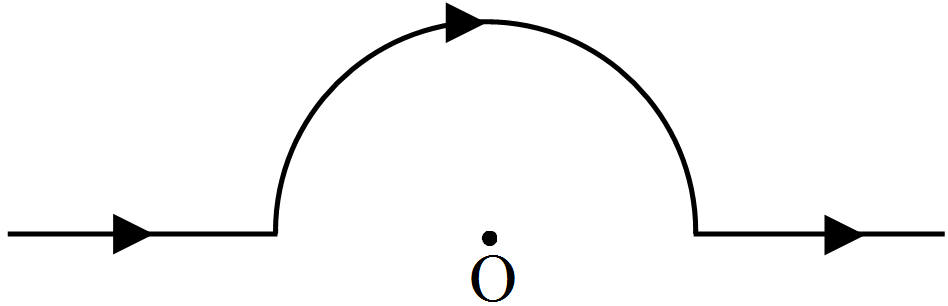
A straight wire carrying a current of 12A is bent into a semi-circular arc of radius 2.0cm as shown. What is the magnetic field at O due to:

  1. Straight segments.
  2. The semi-circular arc?

Summarise any three experimental features and observation described in the experimental study of photoelectric effect.
Two neutral particles are kept 1m apart. Suppose by some mechanism some charge is transferred from one particle to the other and the electric potential energy lost is completely converted into a photon. Calculate the longest and the next smaller wavelength of the photon possible.
Is the motion of a charge across junction momentum conserving? Why or why not?
Calculate the number of photons emitted per second by a 10W sodium vapour lamp. Assume that 60% of the consumed energy is converted into light. Wavelength of sodium light = 590nm.
When can a charge act as a source of electromagnetic wave? How are the directions of electric and magnetic field vectors, in an electromagnetic wave related to each other and to the direction of propagation of the wave?
Which physical quantity, if any, has the same value for waves belonging to the different parts of the electromagnetic spectrum?
A river 400m wide is flowing at a rate of 2.0m/s. A boat is sailing at a velocity of 10m/s with respect to the water, in a direction perpendicular to the river.
  1. Find the time taken by the boat to reach the opposite bank.
  2. How far from the point directly opposite to the starting point does the boat reach the opposite bank?
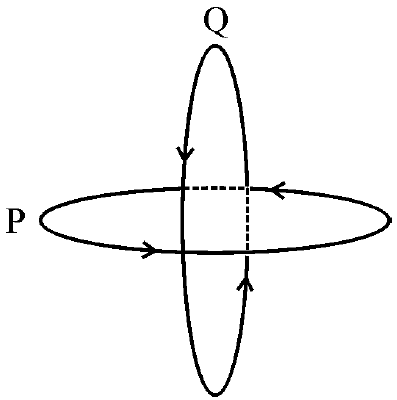
Two identical coils P and Q each of radius R are lying in perpendicular planes such that they have a common centre. Find the magnitude and direction of the magnetic field at the common centre of the two coils, if they carry currents equal to $\text{I}$ and $\sqrt{3\text{I}}$ respectively.


Three equal charges, 2.0 × 10-6C each, are held fixed at the three corners of an equilateral triangle of side 5cm. Find the Coulomb force experienced by one of the charges due to the rest two.