Question
Is the magnification equal to the magnifying power in this case? Explain.

Answer

Near point, D = 25 cm
Distance where the object is kept, u = 7.14 cm
Magnifying power of the lens, $\text{m}=\frac{\text{D}}{\text{u}}$
$=\frac{25}{7.14}$
= 3.5
Here, in this case since the image is formed at the least distance of distinct vision, the magnifying power is equal to the magnitude of magnification.

Need a full question paper?

Generate a complete, print-ready paper with questions like this in minutes — across 16+ boards, with answer keys.
Start Generating Free

Similar questions

A force F is applied on a block of mass M. The block is displaced through a distance d in the direction of the force. What is the work done by the force on the block? Does the internal energy change because of this work?
What is the frequency range of T.V. transmission? Which method of propagation is used for it ?
Given a uniform electric field $\overrightarrow{\text{E}} = 2 \times 10^3\ \hat{i}\  N/C$ find the flux of this field through a square of side $20 \ cm,$ whose plane is parallel to the $y-z$ plane. What would be the flux through the same square, if the plane makes an angle of $30^{\circ}$ with the$ x-$axis?
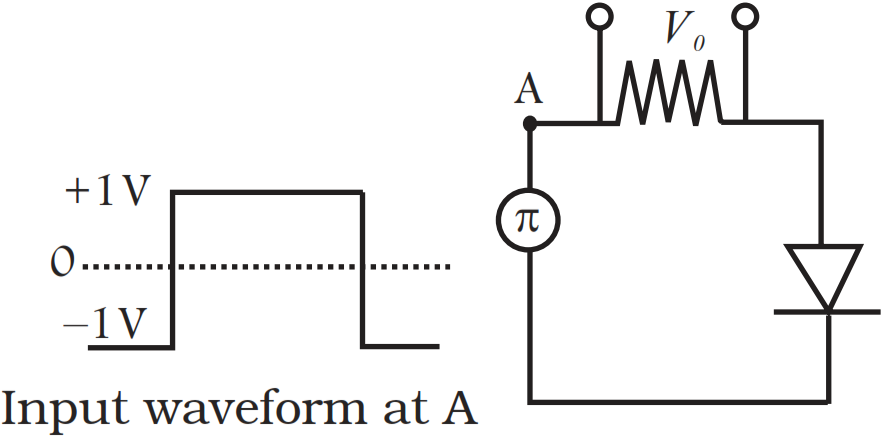
Draw the output waveform across the resistor (Fig).
A classroom demonstration of Newton's first law is as follows: A glass is covered with a plastic card and a coin is placed on the card. The card is given a quick strike and the coin falls in the glass.
  1. Should the friction coefficient between the card and the coin be small or large?
  2. Should the coin be light or heavy?
  3. Why does the experiment fail if the card is gently pushed?
An electron is placed in an electric field. If a proton is placed in its place, what will be the relation between the forces experienced by them?
Describe briefly, with the help of a diagram, the role of the two important processes involved in the formation of a p-n junction.
Electrons are continuously mobile in any conductor but then too, no electric current flows in the conductor till an electric source is joined across its ends. Explain.
The equation of refraction at a spherical surface is $\frac{\mu_2}{\text{v}}-\frac{\mu_1}{\text{u}}-=\frac{\mu_2-\mu_1}{\text{R}}.$ Taking $\text{R}=\infty,$ show that this equation leads to the equation $\frac{\text{Real depth}}{\text{Apparent depth}}=\frac{\mu_2}{\mu_1}$ for refraction at a plane surface.
An equilateral glass prism has a refractive index 1.6 in air. Calculate the angle of minimum deviation of the prism, when kept in a medium of refractive index $\frac{4\sqrt2}{5}.$