Question
Is there any lower limit to the electric force between two particles placed at a separation of 1cm ?

Answer

Yes, there's a lower limit to the electric force between two particles placed at a separation of 1cm, which is equal to the magnitude of force of repulsion between two electrons placed at a separation of 1cm.

Need a full question paper?

Generate a complete, print-ready paper with questions like this in minutes — across 16+ boards, with answer keys.
Start Generating Free

Similar questions

On what does the work function of a metal depend?
A current of 10A is established in a long wire along the positive z-axis. Find the magnetic field $\overrightarrow{\text{B}}$ at the point (1m, 0, 0).
Write a short note : Size of the nucleus
###
How the radius of the nucleus is estimated?
Explain.
Show mathematically how Bohr's postulate of quantization of orbital angular momentum in hydrogen atom is explained by de-Broglie's hypothesis.
Two spherical balls of mass 10kg each are placed 10cm apart. Find the gravitational force of attraction between them.
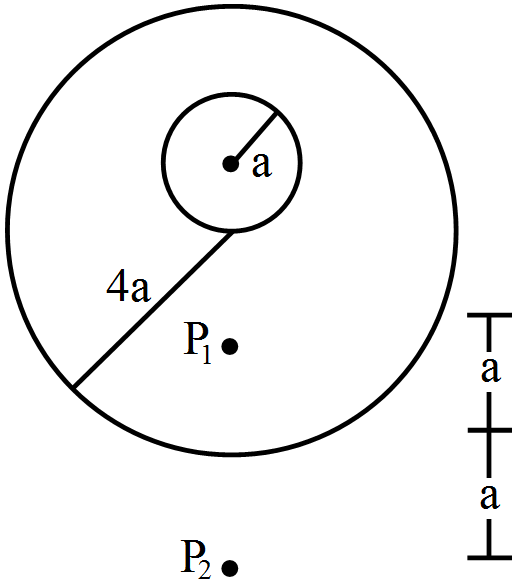
A uniform metal sphere of radius a and mass M is surrounded by a thin uniform spherical shell of equal mass and radius 4a The centre of the shell falls on the surface of the inner sphere. Find the gravitational field at the points P1 and P2 shown in the figure.

The mass of cyclist together with the bike is 90kg. Calculate the increase in kinetic energy if the speed increases from 6.0km/h to 12km/h.
The electric field E due to any point charge near it is defined as $\text{E}=\lim\limits_{\text{q}\rightarrow0}\frac{\text{F}}{\text{q}}$ where q is the test charge and F is the force acting on it. What is the physical significance of $\lim\limits_{\text{q}\rightarrow0}$ in this expression?
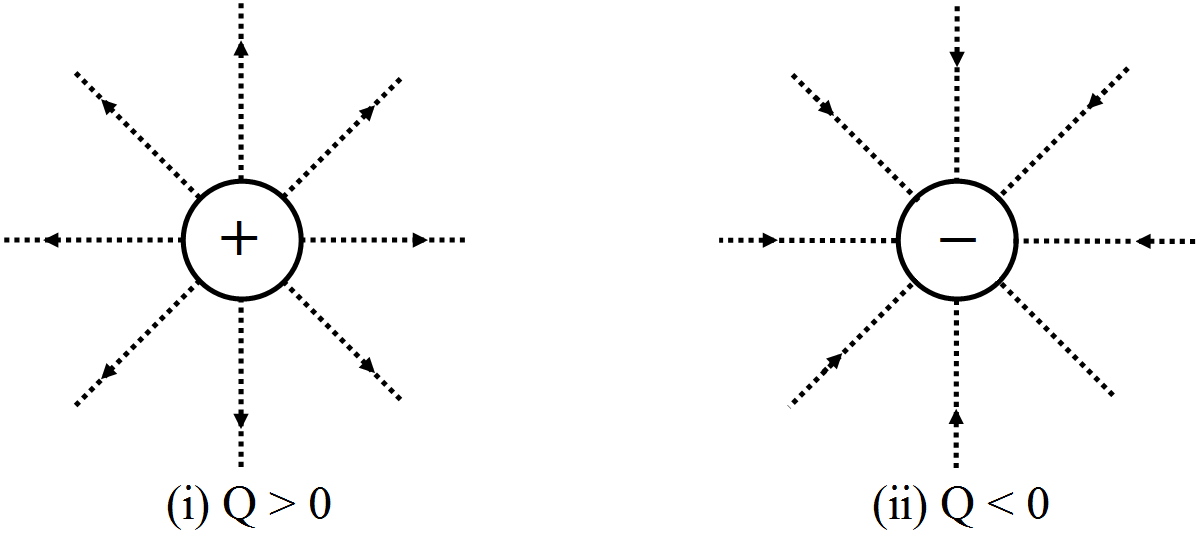
Draw the electric lines of point charge Q when,
  1. Q > 0
  2. Q < 0.

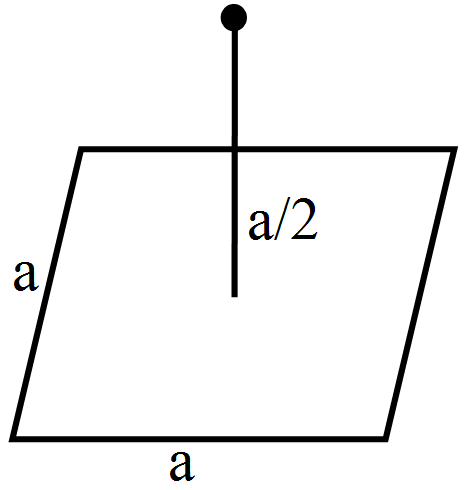
A charge Q is placed at a distance $\frac{\text{a}}{2}$ above the centre of a horizontal, square surface of edge a as shown in figure. Find the flux of the electric field through the square surface.

What is the ratio of first excited state and corresponding orbital radius of ground state in hydrogen atom?