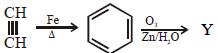
MCQ
is
  • A
    $\begin{array}{*{20}{c}}
      {C{H_2} - OH} \\ 
      {|\,\,\,\,\,\,\,\,\,\,\,\,\,\,\,\,\,\,\,\,\,\,\,\,\,} \\ 
      {C{H_2} - OH} 
    \end{array}$
  • B
    $CH_3-CH_2-OH$
  • C
    $CH_3-COOH$
  • $\begin{array}{*{20}{c}}
      {CH = O} \\ 
      {|\,\,\,\,\,\,\,\,\,\,\,\,\,\,\,\,\,\,\,} \\ 
      {CH = O} 
    \end{array}$

Answer

Correct option: D.
$\begin{array}{*{20}{c}}
  {CH = O} \\ 
  {|\,\,\,\,\,\,\,\,\,\,\,\,\,\,\,\,\,\,\,} \\ 
  {CH = O} 
\end{array}$
d

Need a full question paper?

Generate a complete, print-ready paper with questions like this in minutes — across 16+ boards, with answer keys.

Start Generating Free

Similar questions

Identify the correct order of the size of the following:
The Gibbs energy for the decomposition of $Al_2O_3$ at $500\,^oC$ is as follows

$\frac{2}{3}A{l_2}{O_3} \to \frac{4}{3}Al + {O_2},{\Delta _r}G =  + 940\,kJ\,mo{l^{ - 1}}$

The potential difference needed for the electrolytic reduction of aluminium oxide ............... $\mathrm{V}$

Ethyl acetate at room temperature is a
Vessel-$1$ contains $w _2 g$ of a non-volatile solute $X$ dissolved in $w _1 g$ of water. Vessel-$2$ contains $w _2 g$ of another non-volatile solute $Y$ dissolved in $w _1 g$ of water. Both the vessels are at the same temperature and pressure. The molar mass of $X$ is $80 \%$ of that of $Y$. The van't Hoff factor for $X$ is $1.2$ times of that of $Y$ for their respective concentrations. The elevation of boiling point for solution in Vessel-$1$ is. . . . . .$\%$ of the solution in Vessel- $2$.
After understanding the assertion and reason, choose the correct option.
Assertion : In the bonding molecular orbital $(MO)$ of $H_2,$ electron density is increased between the nuclei.
Reason : The bonding $MO$ is ${\psi _A}\, + \,\,{\psi _{B,}}$ which shows destructive interference of the combining electron waves.
The conjugate base in the following reaction ${H_2}S{O_4} + {H_2}O$ $\rightleftharpoons$ ${H_3}{O^ + } + HSO_4^ - $
Which one of the following has an optical isomer ?

($en=$ ethylenediamine)

The resonance hybrid of nitrate ion is
$\begin{array}{*{20}{c}}
  {C{H_3} - CH - C{O_2}K} \\ 
  {|\,\,\,\,\,\,\,\,} \\ 
  {C{H_3} - CH - C{O_2}K} 
\end{array}\xrightarrow{{electrolysis}}(A)\,(Major)$

Major product $(A)$ of the above reaction

In the reaction: ${H_2}S$ $\rightleftharpoons$ $2{H^ + } + {S^{ 2- }}$, when $N{H_4}OH$ is added, then