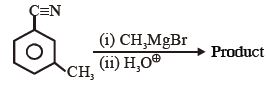
is
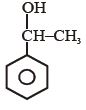
- A
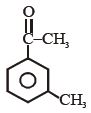
- B
- C

- D

Difficult


Download our appand get started for free
Experience the future of education. Simply download our apps or reach out to us for more information. Let's shape the future of learning together!No signup needed.*
Similar Questions
- 1Which of the following gives $RNC$, when reacted with $CHC{l_3}$ and $KOH$View Solution
- 2Product $(B)$ in the above reactions isView Solution

- 3View SolutionWhich statement is NOT correct for p-toluenesulphonyl chloride?
- 4View SolutionThe alkyl cyanides when hydrolysed to the corresponding acid, the gas evolved is
- 5View SolutionWhich statement is not correct
- 6$\mathrm{C}_{6} \mathrm{H}_{5} \mathrm{NO}_{2} \stackrel{\mathrm{Sn}+\mathrm{HCl}}{\longrightarrow}A \,\xrightarrow[\mathrm{{H}^{\oplus}}]{\mathrm{C}_{6} \mathrm{H}_{5} \stackrel{\oplus}{\mathrm{N}}_{2} \stackrel{\Theta}{\mathrm{Cl}}}P$View Solution
$\quad\quad\quad\quad\quad\quad\quad\quad\quad\quad\quad\quad\quad$(Yellow coloured compound)
Consider the above reaction, the Product $"P"$ is:
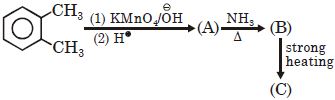
- 7The product $(C)$ will beView Solution
- 8View SolutionReduction of nitroalkanes yields
- 9$[Image]$View Solution
Consider the above reaction. The percentage yield of amide product is ...... . (Round off to the Nearest Integer). (Given : Atomic mass : $C : 12.0\, u , H : 1.0 \,u,N : 14.0\, u , O : 16.0\, u , Cl : 35.5\, u )$

- 10View SolutionWhen methyl iodide is heated with ammonia, the product obtained is