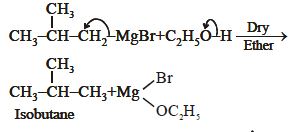
- A$(CH_3)_2CH-CH_2OH$ and $CH_3CH_2MgBr$
- B$(CH_3)_2CH-CH_2CH_2CH_3$ and $Mg(OH)Br$
- C$(CH_3)_2CH-CH=CH_2$ and $Mg(OH)Br$
- ✓$\begin{array}{*{20}{c}}
{C{H_3} - CH - C{H_3}} \\
{|\,\,\,\,\,} \\
{\,\,C{H_3}\,}
\end{array}$ and $CH_3CH_2-OMgBr$
Generate a complete, print-ready paper with questions like this in minutes — across 16+ boards, with answer keys.
$CO(g) + H_2O(g) \rightleftharpoons CO_2(g) + H_2(g)$, at a given temperature, the equilibrium amount of $CO_2(g)$ can be increased by
${{C}_{6}}{{H}_{6}}+C{{H}_{3}}CH=C{{H}_{2}}\xrightarrow[heat]{{{H}_{3}}P{{O}_{4}}}A\xrightarrow[2.\,{{H}_{3}}{{O}^{+}},heat]{1.\,{{O}_{2}},heat}B+C$
The products $(B)$ and $(C)$ are
$Fe ^{2+}( aq )+ S ^{2-}( aq ) \rightleftharpoons FeS ( s )$
When equal volumes of $0.06 M Fe ^{2+}( aq )$ and $0.2 M S ^{2-}( aq )$ solutions are mixed, the equilibrium concentration of $Fe ^{2+}$ (aq) is found to be $Y \times 10^{-17} M$. The value of $Y$ is. . . . .
$[Fe(CN)_6]^{4-} \rightarrow [Fe(CN)_6]^{3-} + e^{-1}\, ;$ $ E^o = -0.35\, V$
$Fe^{2+} \rightarrow Fe^{3+} + e^{-1}\ ;$ $E^o = -0.77\, V$